
The 5 leading cryptocurrencies by market capitalization
A snapshot of the five largest crypto assets by market capitalization — Bitcoin, Ethereum, BNB, XRP and Solana — with data, sources, the role of stablecoins and the limits of the ranking.
Short answer
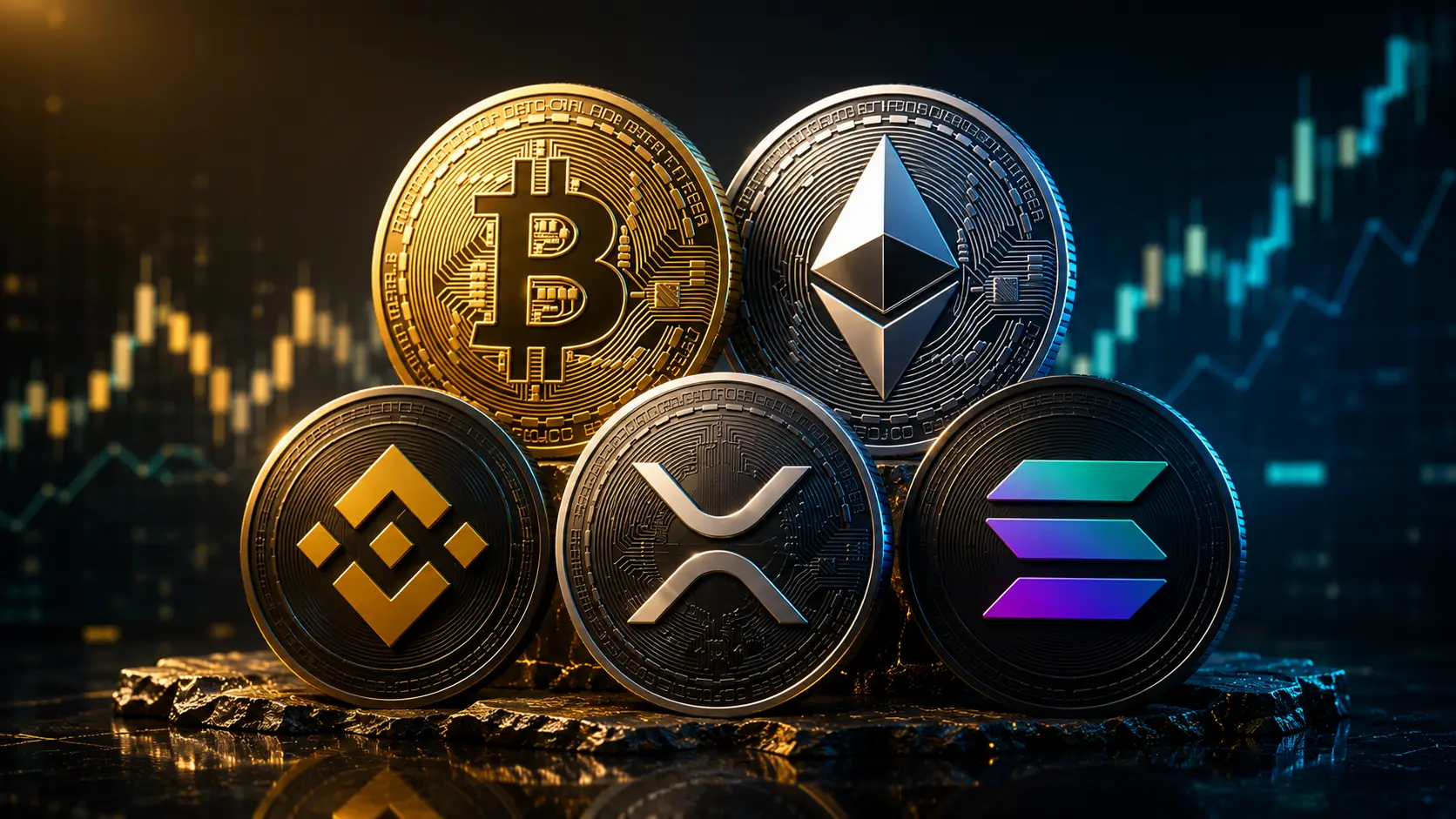
By market capitalization, the five largest cryptocurrencies that are not pegged to the dollar are, in order, Bitcoin (BTC), Ethereum (ETH), BNB, XRP and Solana (SOL). Together they hold most of the market's value. This article shows the figures, the sources and — just as important — what a capitalization ranking does not reveal.
How this list was built
What is measured: market capitalization — the price of one unit multiplied by the circulating supply. It is a measure of scale, not of quality.
Period: data retrieved on 2 September 2026. Prices and positions change every minute.
Scope: global market, in United States dollars.
Source: the public CoinGecko API (global and coin data endpoints).
Method: stablecoins were excluded from the main list. Tether (USDT) and USD Coin (USDC) are among the largest assets by capitalization, but they track the dollar and serve a different purpose; they are covered further down.
Limitations: circulating supply is a provider estimate; capitalization is not money that flowed into the asset; and a one-day snapshot does not describe a trend.
The five largest, in numbers
| Rank | Asset | Approx. price (USD) | Approx. market cap | Market share |
|---|---|---|---|---|
| 1 | Bitcoin (BTC) | 77,300 | US$ 1.55 trillion | ~59% |
| 2 | Ethereum (ETH) | 2,390 | US$ 292 billion | ~11% |
| 3 | BNB | 688 | US$ 92 billion | ~3.5% |
| 4 | XRP | 1.35 | US$ 85 billion | ~3.2% |
| 5 | Solana (SOL) | 100 | US$ 59 billion | ~2.2% |
For context: the total market capitalization of crypto assets was around US$ 2.62 trillion, and Bitcoin dominance — its share of that total — was near 59%. Source: CoinGecko, 2 Sep 2026.
1. Bitcoin (BTC)
Bitcoin was the first cryptocurrency and remains the largest by capitalization by a wide margin. It is a public network for transferring and holding value without relying on a single institution, with supply capped at 21 million units and issuance that roughly halves every four years.
Its high capitalization and dominance near 59% help explain why BTC tends to be the market's reference: when it moves, the rest tends to follow. That guarantees neither stability nor return — the price has fallen more than 70% in previous cycles.
2. Ethereum (ETH)
Ethereum is a network for applications and smart contracts — programs that run automatically under public rules. Much of the stablecoin supply, tokens and decentralized finance applications run on it or on networks built around it.
The second-largest capitalization reflects that broad use, but ETH also depends on technical decisions, competition from other networks and demand for block space. Utility does not remove volatility.
3. BNB
BNB started as the token of the Binance exchange and is now also the native asset of BNB Chain, a smart-contract network. Part of its value is tied to use within the Binance ecosystem, including fee discounts and platform services.
That link to a specific company is an important difference from BTC and ETH: changes in Binance's strategy, rules or regulatory situation can affect the token more directly.
4. XRP
XRP is the native asset of the XRP Ledger, a network aimed at fast, low-cost payment settlement, strongly associated with the company Ripple. It is used mainly for value transfers between parties and cross-border payment pilots.
XRP's history includes court disputes in the United States over its regulatory classification — a reminder that legal factors can weigh as much as technology in an asset's path.
5. Solana (SOL)
Solana is a high-speed, low-fee network, popular with applications that need many operations per second, such as trading and lower-liquidity tokens. SOL is used to pay fees and take part in validating the network.
The network has had outages that required a coordinated restart — a reminder that high performance and operational maturity are different things.
Why stablecoins were left out
If the only criterion were raw capitalization, Tether (USDT), at about US$ 183 billion, would rank third, and USD Coin (USDC), at about US$ 74 billion, would appear right after Solana. We list them separately because a stablecoin has a different goal: keeping its price attached to a reference, almost always the dollar.
That changes the nature of the risk. Instead of price volatility, what matters is the quality of the reserves backing the peg, issuer transparency and the redemption process — covered in the piece on stablecoin volume, liquidity and reserve risk.
What the ranking shows — and what it does not
Shows: relative scale. You can quickly see which assets concentrate value and how large the gap between them is — Bitcoin alone is worth more than the next four combined.
Does not show: real liquidity (how much you can trade without moving the price), ownership concentration (how many wallets hold most of it), degree of decentralization, dependence on a company, new-issuance schedules or any notion of “fair price”. A high capitalization is not the same as safety or future return.
To read the market with more context, it helps to combine capitalization with what the metric measures and omits, with price, volume and dominance on the day and with the phases of the market.
Beginner checklist
- Treat the ranking as a snapshot, not a recommendation: the order changes and has changed many times.
- Before looking at the price, understand what the network is for and who it depends on.
- Check liquidity and concentration, not just capitalization.
- Separate stablecoins from volatile cryptocurrencies: the risk is of a different kind.
- Confirm the figures in more than one source and note the date you checked.
- Do not use your emergency fund and do not decide out of fear of missing out.
Frequently asked questions
Is the largest always the best?
No. Capitalization measures size, not quality, risk or potential. A cryptocurrency can be large and still fall sharply, depend on a company or have concentrated liquidity.
Why is USDT not on the list?
Because it is a stablecoin: its goal is to track the dollar, not to appreciate. By raw capitalization it would be third; by function, it belongs to another category.
How often does the list change?
The top positions (BTC and ETH) have been stable for years. From third place down, the order has shifted several times between BNB, XRP, Solana and other assets, sometimes within weeks.
Informational and educational content. This is not investment advice, nor an offer or solicitation to buy or sell assets.
Sources: CoinGecko — coin data; CoinGecko — global data. Retrieved on 2 Sep 2026.
Articles in this topic: Altcoins and projects
This guide is the main page for the topic. The articles below go deeper into each part.
- Ethereum and altcoins: what they are, risks and advantages for beginners
- Solana: what it is, advantages, risks and how to evaluate SOL
- XRP: from its origins to today and what to expect next
- Dogecoin: past, present and future of the meme coin
- Uniswap: what it is and what to expect from the UNI token
- NEAR Protocol: past, present and future of the blockchain for AI
- SUI token: what it is and what to expect
- Glamsterdam: what Ethereum's next upgrade means for beginners
- Ethereum upgrade: what changed with Fusaka — and what investors do not need to do
- Ethereum after Pectra and Fusaka: three signals to follow
Read more
A sound market reading combines data, context and clear risk limits.