
Dogecoin: past, present and future of the meme coin
Dogecoin's story from 2013 to 2026: from a Shiba Inu meme joke to the 2021 boom, how the network works, ETFs, US regulation and the risks and scenarios for DOGE's future.
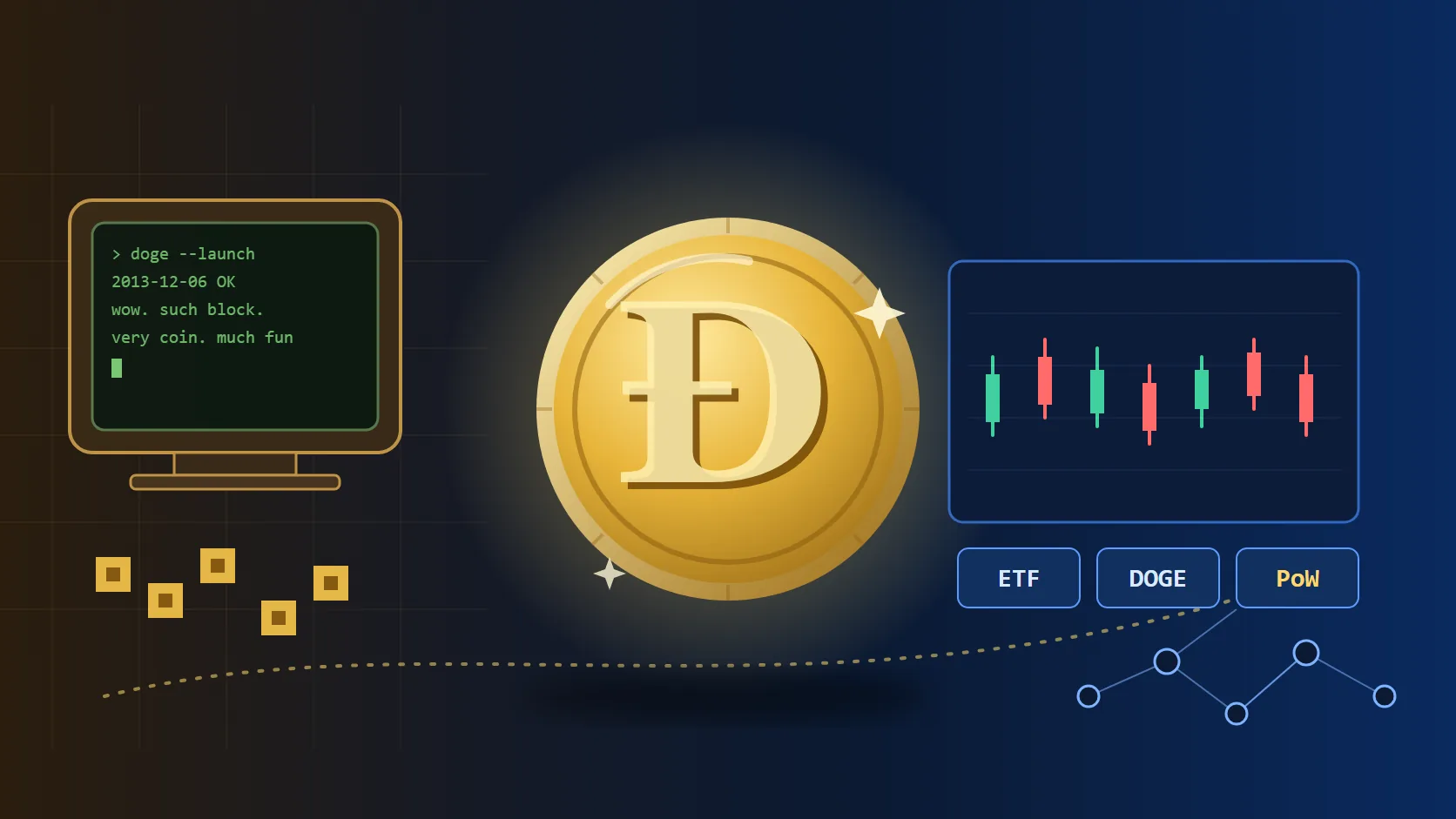
Direct answer
Dogecoin (DOGE) is a cryptocurrency launched on December 6, 2013 by Billy Markus and Jackson Palmer, built on Bitcoin's code as a joke inspired by the Shiba Inu "Doge" meme. The joke became one of the best-known cryptocurrencies in the world: in May 2021 the price reached US$ 0.73 and the market value passed US$ 85 billion. In September 2026 DOGE trades around US$ 0.085, ranks 12th by market capitalization and has exchange-traded funds (ETFs) in the United States, although with little money invested. In March 2026 the SEC and CFTC also named it as an example of a "digital commodity". None of this removes the risks: Dogecoin has no supply cap, depends heavily on attention and market sentiment, and has fallen more than 88% from its all-time high. This text tells the story of DOGE, explains how the network works, shows what changed in 2026 and discusses scenarios for the future, without promising returns.
Past: from joke to phenomenon (2013–2020)
In 2013 Bitcoin was already known, but crypto was still seen as serious and technical. Billy Markus, a software engineer, and Jackson Palmer, who worked in marketing, wanted the opposite: a light, fun and friendly coin with the "Doge" meme dog as its symbol. Dogecoin launched on December 6, 2013 and, according to the project's history page, drew more than a million visitors in its first month and became a popular "tipping coin" on Reddit.
The start was eventful. In December 2013 the price rose about 300% in 72 hours and, on the 25th, a popular online wallet, Dogewallet, was hacked. In February 2014 Palmer announced the end of the original cap of 100 billion coins, which would be reached in 2015, and Dogecoin began issuing new coins continuously. In March 2014 the block reward became fixed at 10,000 DOGE.
The community also became known for charity. In 2014, DOGE donations helped send the Jamaican bobsled team to the Winter Olympics (about 26.5 million DOGE, roughly US$ 30,000 at the time) and fund water wells in Kenya (more than 40 million DOGE, also around US$ 30,000).
A serious technical problem also appeared in 2014: with fast issuance and little mining power, the network risked an attack. The answer was merge mining with Litecoin, which began on September 11, 2014. In practice, people mining Litecoin can contribute computing power that also helps secure Dogecoin. In the following years Markus and Palmer stepped away, and the project came to be maintained by a team of volunteer developers. The lowest price recorded by CoinGecko was US$ 0.0000869, on May 5, 2015.
The 2021 boom and the Elon Musk era
After years out of the spotlight, DOGE exploded in 2021. In January it rose about 800% in 24 hours to near US$ 0.07; in April it reached US$ 0.10 for the first time and in May it passed US$ 0.50. According to CoinGecko, the all-time high was US$ 0.7316 on May 7, 2021. Entrepreneur Elon Musk, who often commented on the coin on social media, became the public face of the rally. On May 8, 2021, during his appearance on Saturday Night Live, the price fell as much as 29.5% within hours, an example of how expectations around one person can turn into volatility.
On December 14, 2021, DOGE rose more than 20% after the announcement that Tesla would accept the coin for branded merchandise. In August 2021 the Dogecoin Foundation, established in 2014, was officially re-established to support the network's development and adoption.
Interest returned in waves: in April 2023 the Twitter logo was replaced with the Doge meme for a few days; in November 2024 the price reacted to the announcement of the US Department of Government Efficiency, whose acronym is also DOGE (the name is only a coincidence, with no technical link to the cryptocurrency).
What Dogecoin is and how it works
Dogecoin is its own open blockchain with no owner. A blockchain is a public record of transactions kept by many computers at the same time. A few technical points help explain DOGE:
- Proof of work (PoW) with Scrypt: like Bitcoin, DOGE is validated by miners. The difference is the algorithm, Scrypt, the same one Litecoin uses.
- 1-minute blocks: a new block is created about once a minute, making confirmations faster than on Bitcoin.
- Fixed reward: each block generates 10,000 DOGE. There is no "halving" (scheduled reduction) as on Bitcoin.
- Unlimited supply: instead of a maximum cap, DOGE has continuous issuance. Public sources cite about 5 billion new coins a year. From the rules above (10,000 DOGE per block, one block per minute), Cripto View's calculation gives roughly 5.3 billion a year, or around 3% a year on the roughly 156 billion in circulation. This is an estimate, not an official figure.
- Merge mining with Litecoin: the network's security also relies on the work of Litecoin miners.
In practice DOGE was designed for small payments and tips, but most of today's volume comes from trading on exchanges rather than use as a means of payment.
Present: DOGE in September 2026
Dogecoin entered 2026 with a more institutional market, though only modestly:
- ETFs in the US: the REX-Osprey DOGE ETF (DOJE) listed on September 18, 2025 on Cboe. Grayscale (GDOG) and Bitwise (BWOW) followed in November 2025 on NYSE Arca. The 21Shares Dogecoin ETF (TDOG) began trading on Nasdaq on January 22, 2026. According to Finder, DOJE, the largest, held about US$ 16.7 million in assets on June 4, 2026, far less than Bitcoin and Ethereum ETFs. On September 10, 2026, Bitwise announced the liquidation of BWOW, with its last trading day expected on October 14.
- Regulation in the US: on March 17, 2026 the SEC and CFTC published a joint interpretation (Release No. 33-11412) naming Dogecoin among the assets treated as digital commodities, based on the asset's characteristics as of the publication date. That is not a safety seal or a guarantee of appreciation.
- Development: the latest stable Dogecoin Core version listed on GitHub at the time of consultation was 1.14.9, from December 1, 2024. The Dogecoin Foundation maintains a "Trailmap" with projects such as Libdogecoin, GigaWallet and the Dogecoin Standard, aimed at easing payment and wallet integration.
The price, meanwhile, is far from its peak. On September 20, 2026, CoinGecko showed DOGE near US$ 0.085, about 88% below the May 2021 high.
Numbers in perspective (September 2026)
| Indicator | Value | Source, period and scope |
|---|---|---|
| Launch | Dec 6, 2013 | Dogecoin.com, project history |
| Price | ≈ US$ 0.085 | CoinGecko, consulted Sep 20, 2026; global market average |
| Market capitalization | ≈ US$ 13.3 bn (12th) | CoinGecko, Sep 20, 2026 |
| 24-hour volume | ≈ US$ 952 mn | CoinGecko, Sep 20, 2026; sum of tracked exchanges |
| Circulating supply | ≈ 156 bn DOGE | CoinGecko, Sep 20, 2026; no maximum cap |
| All-time high | US$ 0.7316 | CoinGecko; May 7, 2021 |
| Block reward | 10,000 DOGE | Wikipedia; blocks of about 1 minute |
| Assets of largest ETF (DOJE) | ≈ US$ 16.7 mn | Finder, Jun 4, 2026; US-listed product |
Price, market cap and volume change every minute and vary by source. Treat the numbers as a snapshot of the consultation date, not a permanent reference.
What the data show and what they do not
They show: that DOGE remains among the largest cryptocurrencies by market value with high exchange liquidity; that institutional interest exists but is still small in ETFs; and that the price is far more volatile than the market average.
They do not allow concluding: that DOGE will be used as a means of payment at scale; that ETFs will attract more money; that today's regulatory classification will last; or that the coin will recover previous highs. The table's numbers come from different platforms and dates and do not represent the behavior of the whole market or of every exchange.
Advantages and limitations
Observed advantages: a network with more than ten years of operation, fast confirmations, low fees, merge mining with Litecoin, a large community and presence on many exchanges and in regulated US products.
Limitations and points of attention: an uncapped supply that dilutes holders over time; strong dependence on attention, social media and public figures; slower development than networks that update often; and little ETF demand so far.
Future: possible scenarios, not predictions
Nobody knows DOGE's future price. What exist are paths that could shape the coin's role:
- Payments use: if tools such as Libdogecoin and GigaWallet are adopted by shops and apps, DOGE could gain more real use. Today that is still a bet, not a fact.
- Financial products: the closure of Bitwise's ETF shows institutional demand for DOGE is still limited. New products may appear, but the market decides whether they find an audience.
- Regulation: the March 2026 interpretation applies as of its publication date and may change with new laws or decisions.
- Attention and culture: DOGE has shown it rises and falls with news, memes and celebrity comments. That cycle may repeat, in both directions.
- Supply: continuous issuance tends to weigh on value per unit unless demand grows in proportion.
Risks and precautions
- Extreme volatility: drops of more than 80% have happened and may happen again.
- Attention risk: a sentence from a public figure can move the price in minutes, up or down.
- Product liquidity risk: some DOGE ETFs have very small assets and can be shut down, as Bitwise's was.
- Regulatory risk: rules change, and product and exchange availability in Brazil may differ from the US. Always confirm on the institution's official site.
- Scams: "meme" coins attract quick-profit promises, fake giveaways and copycat tokens. Distrust any guarantee of returns.
- Custody and security: keeping DOGE on an exchange carries the platform's own risk; use two-factor authentication and keep recovery phrases offline.
Checklist before studying Dogecoin
- Understand the difference between DOGE (the coin), the Dogecoin network and the Dogecoin Foundation.
- Check price, market cap and volume in more than one source, with date and time.
- Consider the unlimited supply when assessing long-term value.
- Before looking at ETFs, confirm the product is available to you and check its assets and fee.
- Decide in advance how much you could afford to lose and do not invest money you need.
- Distrust return promises and content that depends on a single celebrity.
Frequently asked questions
Does Dogecoin have a coin limit like Bitcoin?
No. Bitcoin is capped at 21 million units. Dogecoin abandoned its 100 billion cap in 2014 and issues new coins continuously, on the order of billions a year.
Who created Dogecoin?
Engineers Billy Markus and Jackson Palmer, on December 6, 2013. Both stepped away from the project in the following years, and it came to be maintained by volunteer developers and supported by the Dogecoin Foundation.
Does Elon Musk own Dogecoin?
No. Dogecoin is an open network with no owner. Musk is a public supporter and has influenced the price with social media comments, but he does not control the network.
Is there a Dogecoin ETF?
Yes, in the United States there are spot or similar ETFs, such as DOJE, GDOG and TDOG, and BWOW is being liquidated. They are US-listed products; availability for Brazilian investors depends on the broker and the applicable rules. An ETF does not remove DOGE's market risk.
Is Dogecoin a good investment?
This text makes no recommendation. DOGE is a highly volatile asset with unlimited supply and strong dependence on attention. Anyone studying it should weigh goals, time horizon, loss tolerance and current sources.
Read also
- The 5 leading cryptocurrencies by market capitalization
- XRP: from its origins to today and what to expect next
- Bitcoin price history: cycles and maximum drawdowns
- Crypto ETFs: what changes for beginners and what stays the same
- Risk, liquidity and discipline: how a good idea can become poor execution
Informational and educational content. It is not investment advice, an offer or a solicitation to buy or sell assets.
Sources: Dogecoin.com — history of Dogecoin; Wikipedia — Dogecoin; CoinGecko — DOGE price, market cap, supply and all-time high; CoinDesk — start of merge mining with Litecoin (2014); GitHub — Dogecoin Core releases; Dogecoin Foundation — Trailmap; Finder — spot Dogecoin ETFs (updated Jun 10, 2026); Yahoo Finance — 21Shares ETF launch on Nasdaq; Norton Rose Fulbright — SEC/CFTC joint interpretation (Mar 17, 2026); PR Newswire — Bitwise Dogecoin ETF liquidation. Consulted on Sep 20, 2026.
Read more
A sound market reading combines data, context and clear risk limits.