
NEAR Protocol: past, present and future of the blockchain for AI
The history of NEAR Protocol: from its origins as an artificial intelligence project in 2017 to the network's 2020 launch, the 2024 pivot to 'blockchain for AI,' the 2026 landscape with NEAR Intents, and the risks and scenarios for NEAR's future.
Direct answer
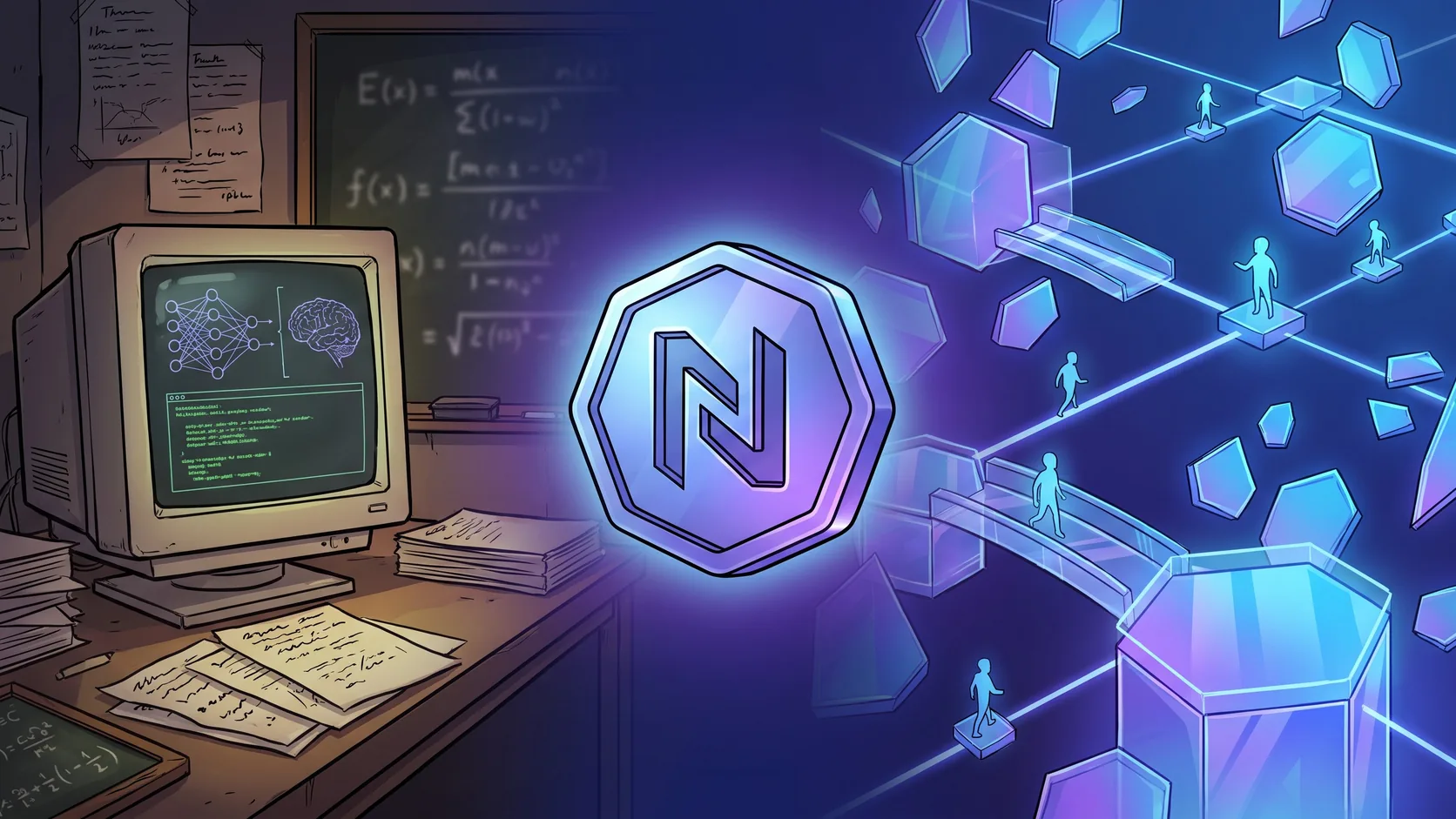
NEAR Protocol is a layer-1 blockchain created by Illia Polosukhin and Alexander Skidanov, two researchers who set out in 2017 to build an artificial intelligence platform and only pivoted to blockchain after running into Ethereum's limitations while trying to pay their own contributors. The network went live in April 2020 and became known for a sharding design called Nightshade and for human-readable account names instead of long addresses. In May 2024, the project announced a strategic pivot: it repositioned itself as the "blockchain for user-owned AI," backed by its own research lab, NEAR AI, led by Polosukhin — a co-author of the paper that introduced the Transformer architecture used in today's language models. As of September 2026, the NEAR token trades at around $4.35, with a market cap near $5.7 billion and the 21st spot among cryptocurrencies by market capitalization, after a rally of more than 80% in seven days driven by progress on the NEAR Intents product line. Even so, the price remains about 79% below its all-time high of $20.37, reached in January 2022. This article explains where NEAR came from, how the network works, what changed with the pivot to AI, and which risks to weigh before following the project.
Where NEAR came from
NEAR's story doesn't start like most blockchains'. Illia Polosukhin, a machine learning researcher who had worked on AI teams at Google — and a co-author of the influential "Attention Is All You Need" paper, which introduced the Transformer architecture still used in language models today — and Alexander Skidanov, an engineer who built one of the first production-grade distributed databases at MemSQL, founded an initiative called NEAR.ai in 2017, focused on an AI problem known as program synthesis.
To pay contributors scattered around the world, the pair tried using smart contracts on Ethereum. In practice, the cost and capacity limits of the network at the time made that approach unworkable. Rather than give up, Polosukhin and Skidanov decided to build their own blockchain, formally starting development of the NEAR protocol in August 2018 with a small team of engineers.
The project raised funding over the following years — including a seed round led by Metastable Capital in 2019 — and went through testnet phases before closing a $21.6 million round led by Andreessen Horowitz (a16z) in May 2020. The network went live in April 2020, initially with restricted participation, and became fully community-operated by its validators in September of that year. In August 2020, the NEAR token held a public sale on the CoinList platform, which saw demand high enough to crash the exchange's website on the day of the event. Combined with other rounds, the project had raised roughly $150 million by early 2022.
What NEAR is and how the network works
NEAR Protocol is a proof-of-stake blockchain: validators stake NEAR tokens to earn the right to process transactions and produce blocks, receiving rewards in return. The project's best-known technical feature is Nightshade, a sharding design that splits the network's processing into smaller pieces — called "chunks" — within each block, instead of creating separate parallel chains. That lets network capacity scale in proportion to the number of shards without giving up the cross-contract composability that other sharding approaches sacrifice.
In August 2024, the network received an upgrade called Nightshade 2.0, which introduced stateless validation: validators can now verify transactions without storing the full state of each shard locally, instead fetching the data they need directly from the network. That lowers the hardware requirements for running a validator and increases the network's processing capacity.
Another usability feature of NEAR is its human-readable account names — such as "wallet.near" — instead of long hexadecimal addresses, along with nested sub-accounts designed to make it easier for everyday users and applications to interact with the network. In November 2021, the ecosystem also gained Aurora, an Ethereum Virtual Machine (EVM)-compatible layer built on top of NEAR that lets contracts and assets originally built for Ethereum run with lower fees.
The NEAR token has three core functions within the protocol: paying transaction fees (gas); being staked to help secure the network and earn rewards; and covering "storage staking," a small deposit locked per account or contract to fund on-chain data storage, refunded if the data is removed.
The pivot to artificial intelligence (2024)
On May 22, 2024, Illia Polosukhin published "User-Owned AI is NEAR," in which the team laid out the thesis that would go on to guide the project's roadmap: turning NEAR into the infrastructure for "user-owned AI," in contrast to AI models controlled by large technology companies. Around the same time, the NEAR Foundation announced the launch of NEAR AI, a research and development lab dedicated to decentralized artificial intelligence, led by Polosukhin, along with an incubation and investment arm meant to fund AI projects built on the network.
The core thesis is that autonomous AI agents — software capable of making decisions and acting on its own — will need a dedicated execution layer to own assets, sign transactions, and operate across different networks without depending on a centralized platform. According to Polosukhin, the goal is to make NEAR "the place where any AI application and novel consumer use case can leverage the best user-owned AI infrastructure, accessible to everyone in the Web3 ecosystem." That shift in messaging repositioned the project: from a general-purpose blockchain competing for traditional decentralized-application developers, to a network presenting itself as a settlement layer for AI agents.
NEAR in 2026: Intents, chain abstraction and new tokenomics
Through 2025 and 2026, NEAR built a technical stack around that thesis, made up of four pieces: Chain Signatures, which lets a NEAR account control addresses and sign transactions on other blockchains; Omnibridge, a bridge between networks; Shade Agents, a design for AI agents to operate with keys and verifiable execution; and NEAR Intents, a system, still in beta, in which users and agents declare the outcome they want — for example, swapping one asset for another — and a competitive market of "solvers" decides the best execution route across more than 30 blockchains, without the user having to manually pick which network to use. On September 21, 2026, NEAR Intents added support for limit orders, expanding the types of operations available within the system.
The project also revised its token economics. A governance update approved in late 2025, nicknamed the "Halving Upgrade," cut NEAR's maximum annual inflation from 5% to 2.5%, reducing dilution for anyone not staking. In parallel, a mechanism called the "Intents Fee Switch" began routing a share of protocol revenue toward buying back NEAR tokens on the market.
That combination of changes, together with market appetite for AI narratives, coincided with a sharp price rally in September 2026: a roughly 81% gain over seven days, outperforming the broader crypto market over the same period. On September 21, an 11.5% intraday surge liquidated about $8.88 million in leveraged short positions on the asset. Moves of that size within a few days are typical of mid-cap assets and tend to be followed by corrections — they should not be read as a guaranteed continuing trend.
Numbers for context (September 2026)
| Indicator | Value | Note |
|---|---|---|
| Development started | Aug. 2018 | As a pivot from an AI project |
| Mainnet launch | Apr. 2020 | Fully community-operated by Sep. 2020 |
| Maximum annual inflation | 2.5% | Cut from 5% by the "Halving Upgrade" (late 2025) |
| Circulating supply | ≈ 1.3B NEAR | CoinGecko, Sep. 22, 2026 |
| All-time high | ≈ $20.37 | Jan. 16, 2022 |
| Market cap rank | ≈ 21st largest | CoinGecko, Sep. 22, 2026 |
| Strategic pivot | May 2024 | "Blockchain for user-owned AI" |
Price, market cap and ranking change by the minute; treat the numbers above as a snapshot from the date of consultation, not a permanent reference.
Strengths and limitations
Observed strengths: the Nightshade sharding design lets network capacity scale without relying on isolated parallel chains; human-readable account names simplify the user experience compared with hexadecimal addresses; the Aurora layer offers compatibility with applications originally built for Ethereum; and the 2025 tokenomics revision lowered the maximum dilution from inflation and introduced token buybacks funded by protocol revenue.
Limitations and points to watch: the "blockchain for AI agents" thesis is still a bet on future adoption, not an already-proven use case at scale; the fee revenue generated by the network remains small next to established layer-1 blockchains, raising questions about the long-term economic sustainability of validators; competition for chain abstraction and AI-agent infrastructure is no longer unique to NEAR, with Solana and abstraction layers built on top of Ethereum moving in a similar direction; and the price history shows a drop of more than 75% from its 2022 all-time high, even after the recent rally.
What to expect going forward
A few developments are already underway and help shape scenarios for the coming years, though none of them guarantee the token will appreciate:
- Real adoption of autonomous AI agents: the thesis's success depends on applications actually using Shade Agents and Chain Signatures to operate autonomously with real assets, not just announcements and pilot integrations.
- Effect of token buybacks on supply: the "Intents Fee Switch" only meaningfully reduces sell pressure if the volume processed through NEAR Intents keeps growing consistently; at low revenue, the practical effect on price tends to be small.
- Competition for chain abstraction: Solana and third-party solutions built on Ethereum have been expanding their own cross-chain abstraction features, narrowing NEAR's window of exclusive differentiation on this narrative.
- Regulatory environment for autonomous agents: there is still little legal clarity, in any jurisdiction, on liability and classification for software agents that sign transactions and move assets autonomously — a topic likely to draw more regulatory attention as usage grows.
Treat price predictions — including the most optimistic ones published by exchanges and specialized sites — as speculation, not reliable forecasts. No source can accurately predict the real pace of AI-agent adoption, future regulatory decisions, or market behavior.
Risks and precautions
Consider: market risk and high historical volatility, including sharp rallies followed by corrections; execution risk, since the "blockchain for AI" thesis still depends on adoption that isn't guaranteed; competitive risk, as other layer-1 networks pursue the same chain-abstraction and autonomous-agent narrative; validator economic-sustainability risk, if network fee revenue doesn't grow enough to offset the reduced inflation; and regulatory risk around AI agents that transact autonomously, still poorly defined in most countries. None of these risks is unique to NEAR, but each carries different weight for this specific project.
Checklist before studying NEAR Protocol
- Separate NEAR's track record as a general-purpose blockchain (2020-2023) from the more recent "blockchain for AI" thesis (from 2024 onward) before evaluating the project.
- Track real usage data for NEAR Intents and Shade Agent adoption, not just announcements and partnerships.
- Check the network's fee revenue and how it compares with new token issuance, to understand the real pressure on price.
- Read the official technical documentation on Nightshade and Chain Signatures before accepting simplified comparisons with other blockchains.
- Weigh the asset's volatility history — including drops of more than 75% from its all-time high — before making any decision.
Frequently asked questions
Are NEAR Protocol and NEAR AI the same thing?
Not exactly. NEAR Protocol is the blockchain and the NEAR token. NEAR AI is a research and development lab, created in 2024 and tied to the NEAR ecosystem, dedicated to decentralized, user-owned artificial intelligence.
Why did NEAR's price rise so much in September 2026?
The rally coincided with the launch of new NEAR Intents features, such as limit orders, within a broader crypto market upswing. Sharp gains concentrated in a few days tend to come with elevated volatility in both directions.
What are the AI agents that NEAR promises to enable?
They are autonomous software programs capable of making decisions and executing transactions on their own, without human intervention at every step. NEAR's infrastructure — Chain Signatures, Shade Agents and NEAR Intents — aims to let these agents own assets and operate across different blockchains in a verifiable way.
Does NEAR have a fixed maximum supply, like Bitcoin?
Not in the same way. NEAR doesn't have a hard supply cap like Bitcoin's 21 million; instead, the protocol sets maximum inflation parameters adjustable through governance, currently 2.5% a year after the cut approved in late 2025.
Is it worth investing in NEAR because of the AI narrative?
That depends on your risk profile, and it isn't something this article can answer for you. The "blockchain for AI" thesis doesn't yet have proven adoption at scale, the asset's price is historically volatile, and no price projection should be treated as a guarantee.
Read also
- The 5 leading cryptocurrencies by market cap
- Solana for beginners: what it is and how it works
- What is blockchain: what it's for and how it's used today
- Crypto glossary for beginners: market terms explained simply
Informational and educational content. It does not constitute investment advice, an offer, or a solicitation to buy or sell any asset.
Sources: NEAR.org — official project history and roadmap; Wikipedia — NEAR (blockchain platform); Illia Polosukhin — "User-Owned AI is NEAR" (May 2024); Decrypt — NEAR AI research lab launch; NEARWEEK — Nightshade 2.0; NEAR.org — chain abstraction, Chain Signatures and NEAR Intents; Crypto.news — NEAR's bet as a settlement layer for AI agents; CoinList — announcement of the NEAR token public sale (2020); CoinGecko — NEAR price, market cap and ranking. Consulted on Sep. 22, 2026.
Read more
A sound market reading combines data, context and clear risk limits.