
How cryptocurrencies are used in the real world today
Cross-border remittances, digital dollars, card settlement, investing, tokenized bonds and humanitarian aid: six real uses of cryptocurrencies, with 2026 data, sources and limits.
Quick answer
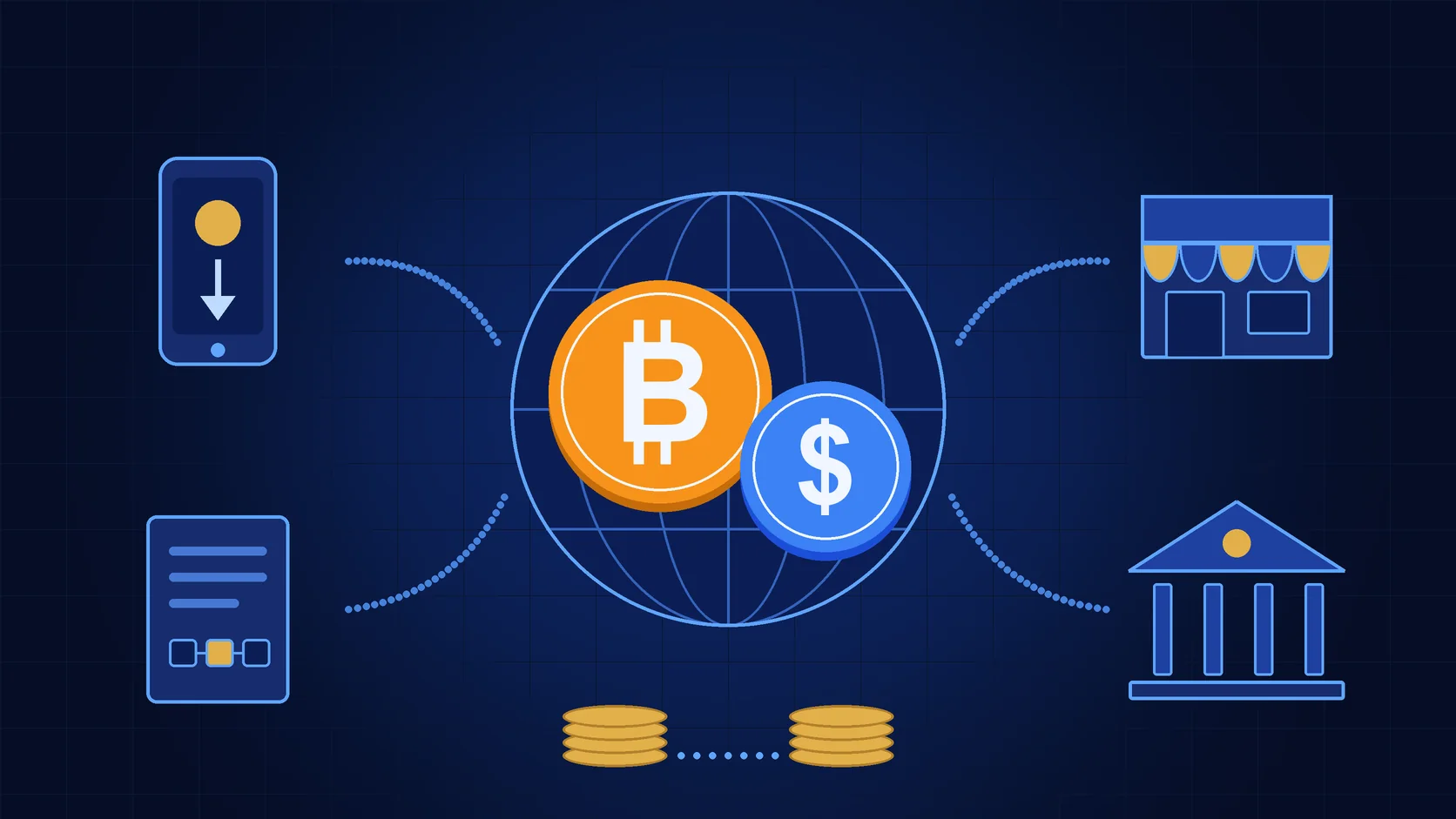
Beyond buying and selling on exchanges, cryptocurrencies are used today mainly in six ways: sending money across borders, holding value in digital dollars and paying people and suppliers, settling payments between companies, investing and holding reserves, trading tokenized bonds and funds and distributing humanitarian aid. In almost all of these uses, the instrument is not Bitcoin or a volatile coin, but stablecoins, tokens that track the value of the US dollar.
Brazil sits at the center of this shift: it ranked first in Chainalysis's 2026 global adoption index, which assessed 117 countries between July 2025 and June 2026. This guide shows each use with an example, the number behind it, the source and what cannot yet be claimed. If you are just starting, first read What stablecoins are: types, how the peg holds and risks.
How this overview was put together
The numbers come from public sources, checked on October 10, 2026. They measure different things and should not be added together.
- Chainalysis: reports published on September 23, 2026, with data from July 2025 to June 2026. These are estimates built from transactions recorded on blockchains, not a headcount.
- Receita Federal (Brazil's tax authority): transactions reported in Brazil from August 2019 to December 2025.
- World Bank: average cost of international remittances, third-quarter 2025 report.
- RWA.xyz: tokenized-asset dashboard, as of October 10, 2026.
- IMF and UNHCR: official statements on El Salvador (February 2025) and on cash assistance in Ukraine (March 2023).
1. Sending money to another country
This is the use where the data is clearest. According to Chainalysis, cross-border transfers made with stablecoins went from about US$11 billion a month in January 2025 to US$24 billion a month in June 2026. The average transfer was close to US$3,000, which points to individuals and small businesses rather than large institutions.
The interest has a practical reason. According to the World Bank, sending a remittance costs on average 6.36% of the amount sent, more than double the 3% target set by the United Nations. A stablecoin transfer usually has a low network fee, but that is not the total cost: you also have to count the conversion from local currency into the token at the origin, the conversion into local currency at the destination, and the exchange-rate spread at each end. The sources consulted do not offer a comparison of the total cost of the two routes.
2. Holding value in dollars and paying people and suppliers
In countries with high inflation or difficult access to dollars, stablecoins have become a way to preserve purchasing power. Chainalysis estimates that Latin America moved US$593.8 billion in crypto assets during the period, of which US$252.5 billion was in Brazil and US$88.5 billion in Argentina. In Brazil, according to the report, stablecoin activity grew 495%. The report also cites merchants in Venezuela who said they received close to 40% of their income in USDT.
Direct wallet-to-wallet transfers within the same country, without going through an exchange, totaled US$228.7 billion worldwide, up from US$56.8 billion, and 96% of that value was in stablecoins. For Chainalysis, the steady rhythm of these transfers is typical of trade and business activity.
Brazil's official records point the same way. Of the buy and sell transactions reported to the Receita Federal between August 2019 and December 2025, 71.7% of the value involved stablecoins. The data is detailed in Who is entering Brazil’s crypto market? Age, volume and data.
3. Settling payments between companies and on cards
Part of the real-world use happens behind the scenes, where the consumer never sees it. On September 22, 2026, the US bank SoFi and Mastercard announced that settlement of purchases made with the bank's cards is now done with a stablecoin issued by SoFi itself, in a program with expected annualized volume above US$25 billion. The cardholder still sees dollars; what changes is the rail used between the institutions. The case is explained in SoFi and Mastercard put stablecoin settlement into operation.
4. Investing and holding reserves
Bitcoin is used above all as an investment, not as a means of payment. US spot Bitcoin exchange-traded funds (ETFs) took in a net US$21.4 billion in 2025, as shown in Bitcoin and ETFs: why capital inflows do not guarantee a higher price.
El Salvador's experience illustrates the limits of its use as everyday money. The country made Bitcoin legal tender in 2021 and, under the US$1.4 billion arrangement approved by the IMF on February 26, 2025, changed the law: acceptance by the private sector became voluntary and taxes are again paid only in US dollars.
5. Trading tokenized bonds and funds
Tokenizing means recording on a blockchain a claim on a traditional asset. The most developed segment is US Treasury securities: on October 10, 2026, the RWA.xyz dashboard recorded US$14.86 billion distributed across 117 products, held by 86,232 addresses. It is a use concentrated among institutional investors and companies in the sector itself, which park their cash in these funds. For the concepts and risks, see Tokenized real-world assets: what RWAs are and what to ask before investing.
6. Distributing humanitarian aid
In December 2022, UNHCR, the UN Refugee Agency, ran a pilot in Ukraine delivering assistance in USDC directly to the digital wallets of people displaced by the war. According to the agency, the amount could be withdrawn in dollars, euros or local currency at MoneyGram locations or transferred to a bank account. UNHCR itself described the project as small-scale.
Summary table: uses and numbers
| Use | Data point | Source and period |
|---|---|---|
| Cross-border transfers | US$24 billion a month in stablecoins; about US$3,000 per transfer on average | Chainalysis, June 2026 |
| Cost of a traditional remittance | 6.36% of the amount sent, global average | World Bank, Q3 2025 |
| Direct transfers within a country | US$228.7 billion; 96% in stablecoins | Chainalysis, Jul 2025 to Jun 2026 |
| Brazil | US$252.5 billion moved; 1st of 117 countries | Chainalysis, Jul 2025 to Jun 2026 |
| Brazil, reported transactions | 71.7% of the value in stablecoins | Receita Federal, Aug 2019 to Dec 2025 |
| Card settlement | Program with more than US$25 billion in expected annualized volume | SoFi and Mastercard, Sep 22, 2026 |
| US Bitcoin ETFs | US$21.4 billion in net inflows | Full year 2025 |
| Tokenized US Treasuries | US$14.86 billion across 117 products | RWA.xyz, Oct 10, 2026 |
What the data shows and what it does not
It shows that use beyond speculation exists, is growing and is concentrated in stablecoins, with greater weight in emerging countries. It also shows that Brazil is one of the largest markets in the world on this measure.
It does not show how many people use crypto day to day, because the reports measure value moved and one person can have several wallets. Nor does it prove that most activity is payments: in the Chainalysis survey, smaller transfers, classified as retail, totaled US$273 billion out of nearly US$10 trillion, and direct wallet-to-wallet transfers were 2.5% of measured activity. The rest goes through services such as exchanges, and the sources consulted do not separate how much of that is trading and how much is payments. Finally, the purpose of each transfer is inferred from transaction patterns, not declared by whoever made it.
Risks and precautions
- A stablecoin depends on its issuer: the one-dollar value only holds if the company has reserves and honors redemptions. Not all of them publish the same level of information.
- A wrong network or address is final: a transfer sent to the wrong network or address usually cannot be undone.
- Total cost is higher than the network fee: conversion, exchange rates and cash-out at both ends can wipe out the advantage over an ordinary remittance.
- There are rules and taxes: in Brazil, there are crypto reporting obligations to the Receita Federal, and cross-border transfers follow Central Bank rules. See Brazil's Central Bank rules for exchanges and self-custody wallets: the updated guide.
- Real-world use attracts scams: promises of fixed returns in digital dollars and urgent requests for payment in crypto are classic signs of fraud.
- Prices remain volatile outside stablecoins: anyone who receives or holds Bitcoin and other coins can see the value change a lot in a short time.
Checklist before using crypto to pay or send money
- Confirm which stablecoin and which network the other party accepts before sending.
- Send a small amount first and confirm it arrived.
- Add up all the fees: purchase, network, exchange rate and cash-out at the destination.
- Compare the final amount received with that of an ordinary remittance or transfer.
- Check whether the exchange or service you use is authorized to operate in the country.
- Keep proof of origin and of each transaction for your tax return.
- Do not keep in stablecoins an amount you could not accept losing if the issuer or the platform runs into trouble.
Frequently asked questions
What are cryptocurrencies used for most today?
Most of the value moved still goes through exchanges and other services, not direct payments. Beyond trading and investing, the fastest-growing uses are cross-border transfers and payments with stablecoins.
Can you pay for everyday purchases with cryptocurrencies?
In some places and stores, yes, but it is not the most common use. The more frequent route is cards that convert the balance into local currency at the moment of purchase, or direct stablecoin transfers between people and suppliers.
Why do stablecoins dominate real-world use?
Because they track the dollar. Anyone paying or being paid needs to know what the amount will be worth tomorrow, and coins with volatile prices do not offer that.
Is sending money abroad with crypto cheaper?
It can be, but not always. The network fee is usually low, and the conversions at both ends can cost more than it does. Only comparing the final amount received answers the question.
Is Bitcoin an official currency in any country?
El Salvador adopted Bitcoin as legal tender in 2021. Since the 2025 reform, made under the IMF arrangement, accepting Bitcoin is voluntary and taxes are paid only in US dollars.
Does Brazil use cryptocurrencies a lot?
Yes. The country ranked first in Chainalysis's 2026 adoption index, with US$252.5 billion moved between July 2025 and June 2026 and strong growth in stablecoin use.
Informational and educational content. It is not investment advice, an offer, or a solicitation to buy or sell assets.
Sources: Chainalysis — 2026 Global Crypto Adoption Index (Sep 23, 2026); Chainalysis — 2026 LATAM Crypto Adoption (Sep 23, 2026); World Bank — Remittance Prices Worldwide, Q3 2025 report; Receita Federal — study on Brazil's stablecoin market; RWA.xyz — Tokenized Treasuries; IMF — arrangement with El Salvador (Feb 26, 2025); UNHCR — blockchain cash-assistance pilot in Ukraine (Mar 23, 2023). Checked on Oct 10, 2026.
Read more
- What stablecoins are: types, how the peg holds and risks
- How to use stablecoins safely: issuer, network and fees
- Who is entering Brazil’s crypto market? Age, volume and data
- Fees and networks: how to send crypto without getting lost in the details
- SoFi and Mastercard put stablecoin settlement into operation
- Stablecoins 2026: reserves, rules and risks for beginners
A sound market reading combines data, context and clear risk limits.