
What stablecoins are: types, how the peg holds and risks
A beginner's guide to stablecoins: what they are, the types that exist, how the price stays close to one dollar, what they are used for and which risks to consider.
Direct answer: what a stablecoin is
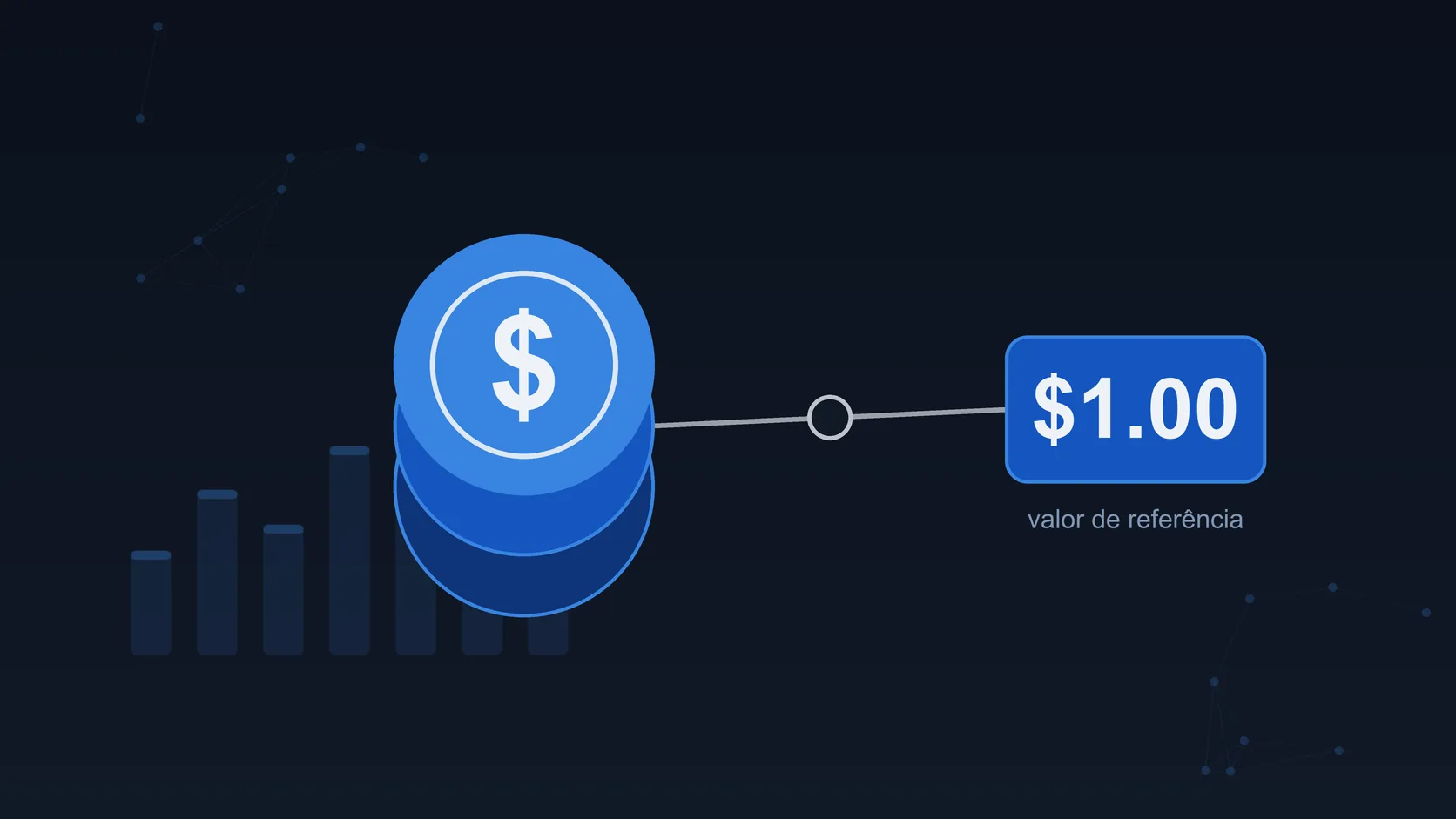
A stablecoin is a cryptocurrency designed to hold a stable price against a reference asset — almost always the US dollar. The goal is to combine two features that usually do not go together: the free movement of a blockchain token and the price predictability of a traditional currency.
Stable, however, does not mean risk-free. The dollar peg depends on reserves, redemption mechanisms and market confidence, and any of those pillars can fail. This guide explains what stablecoins are, which types exist, how the price is kept close to one dollar, what they are used for and which risks to weigh before using them.
Why stablecoins exist
The price of Bitcoin and most cryptocurrencies swings sharply within hours. That makes those assets hard to use for payments, saving or pricing goods. Stablecoins emerged to solve this inside the crypto environment itself: they let you step out of volatility without converting to bank money, they act as a unit of account on exchanges, and they enable fast transfers between platforms.
Over time the use spread beyond trading. Today stablecoins also appear in cross-border remittances, business-to-business payments and dollar access in countries with a weak currency or high inflation. The Bank for International Settlements (BIS) notes that fiat-backed stablecoins mostly track the dollar and that their use is still concentrated in crypto transactions, even though it is broadening.
The four types of stablecoin
Not every stablecoin works the same way. What changes is the backing behind the token — what, in theory, holds the price.
| Type | How it tries to hold the price | Examples | Core risk |
|---|---|---|---|
| Fiat-backed | Reserves in cash and short-term securities, redeemable with the issuer | USDT, USDC | Reserve quality and custody; issuer soundness |
| Crypto-backed (overcollateralized) | Crypto assets locked in contracts, worth more than the amount issued | DAI | Sharp collateral drops and cascading liquidations |
| Algorithmic | Automatic supply rules and incentives, with little or no backing | TerraUSD (UST), which collapsed in 2022 | A loss of confidence that feeds on itself |
| Commodity-backed | Reserves in gold or another physical asset | PAXG, XAUT | Custody of the physical asset and the commodity price |
Fiat-backed
These are the most widely used. A company issues tokens and states that, for every unit in circulation, it holds the dollar equivalent in cash, bank deposits and short-term government securities. Those with direct access can redeem tokens for dollars with the issuer, and it is that redemption that anchors the price in practice. The thing to watch is the reserve: its composition, where it is held and how often it is audited or disclosed. Issuers such as Circle (USDC) and Tether (USDT) publish periodic reserve reports, with different levels of detail.
Crypto-backed
Here no company holds dollars. The user deposits crypto assets, such as ether, into a smart contract and receives stablecoins in return, always worth less than the deposit. That overcollateralization — locking 150 dollars in crypto to issue 100 in stablecoin, for example — acts as a cushion against volatility. DAI, managed by the MakerDAO protocol, is the best-known example. The risk shows up when the collateral falls fast: the system liquidates positions automatically, and in violent drops those liquidations can pile up.
Algorithmic
These promise stability without sufficient reserves, relying on automatic rules that expand or contract supply and on a second token meant to absorb the swings. The model is fragile: if the market loses confidence, the mechanism that was supposed to defend the peg starts to destroy it. That is what happened in May 2022 with TerraUSD (UST), which lost its peg and wiped out tens of billions of dollars in market value. Since then this type is viewed with deep distrust and faces regulatory restriction in several jurisdictions.
Commodity-backed
Each token represents a quantity of a physical asset, usually gold held in a vault. They work more as a digital way to hold gold than as an everyday currency. The price tracks the commodity, so it is not stable against the dollar.
How the price stays near one dollar
Three forces, combined, hold the peg.
Redemption and issuance. When authorized participants can always swap a token for a dollar, and back, arbitrage corrects deviations: if the token drops to 0.99, it pays to buy it cheap and redeem it for a full dollar, which pushes the price back up.
Reserves. The perception that real, accessible backing exists sustains confidence. Opaque or low-quality reserves undermine it.
Market liquidity. Deep buy and sell orders spread across many exchanges absorb shocks without the price drifting.
When one of those forces fails, a depeg occurs. In March 2023, USDC fell to about 0.88 dollar after Circle disclosed that part of its reserves was stuck at Silicon Valley Bank, which had failed; the price recovered in the following days once access to the funds was secured. The episode shows that even a well-regarded stablecoin can depeg over a single reserve problem.
What they are used for
- Volatility shelter: holding value in digital dollars without leaving the blockchain during sharp swings.
- Trading: serving as a pair and a unit of account on most exchanges.
- Transfers: moving value between platforms and countries in minutes, at any hour.
- Payments and remittances: settling accounts between businesses or sending money abroad at potentially lower cost.
- Dollar access: in countries with a weak currency, acting as informal savings in a strong currency, with all the currency and regulatory risks that implies.
- DeFi: serving as the base for lending, liquidity provision and other on-chain financial applications.
Risks and limits
Issuer and reserve risk. If the assets backing the token are insufficient, illiquid or poorly held, the redemption promise weakens.
Counterparty and custody risk. Leaving stablecoins on an exchange means trusting that platform's solvency and security, not just the token issuer.
Depeg risk. The peg is a target, not a guarantee. Temporary depegs have happened even in large stablecoins.
Network and operational risk. The same token exists on several networks (Ethereum, Solana, Tron and others). Sending to the wrong network or an incorrect address can cause irreversible loss.
Freezing risk. Centralized issuers can block specific addresses and balances at the request of authorities or on their own decision.
Regulatory and currency risk. The rules are still being built: there is the MiCA framework in the European Union, recent legislation in the United States and central-bank rules being implemented in Brazil. For someone in Brazil, holding a stablecoin balance is dollar exposure: the value in reais changes even with the peg intact.
Not a bank deposit. A stablecoin has no deposit-insurance guarantee. If the issuer or the platform fails, there is no automatic cover.
Checklist to assess a stablecoin
- Which type is it: fiat-backed, crypto-backed, algorithmic or commodity-backed?
- Who is the issuer, in which country does it operate, and what do the redemption terms say?
- Is there a recent, detailed and preferably audited reserve disclosure?
- On which networks does the token exist, and which one will you use?
- Does the token have liquidity on the exchange or wallet where you plan to operate?
- Is there a history of depegs? What caused it and how was it resolved?
- Does the amount you plan to hold fit the risk of being dollars, not your local currency?
FAQ
Is a stablecoin the same as money in a bank?
No. A bank deposit is a liability of a regulated institution and, up to certain limits, covered by a guarantee fund. A stablecoin is a token issued by a private company whose soundness depends on that company's reserves and rules.
Which stablecoin is the safest?
There is no single answer and no guarantee. Fiat-backed stablecoins with transparent, audited reserves tend to be seen as less risky than algorithmic ones, but all carry issuer, custody and network risk.
Can a stablecoin lose value?
Yes. The price can depeg from its reference temporarily or permanently, and an algorithmic token can collapse. A dollar stablecoin can also lose value against your local currency through exchange-rate moves.
Do I have to report stablecoins in Brazil?
Generally yes. Crypto-asset transactions and balances may have to be reported to the tax authority, and central-bank rules are being implemented. Check the official sources and, if needed, a professional. See the article on the rules in Brazil linked below.
Sources: BIS — Annual Report 2026; BIS — The crypto ecosystem: key elements and risks; Circle — USDC transparency; Tether — transparency; MakerDAO — documentation; Central Bank of Brazil — crypto assets. Accessed Sep 3, 2026.
Informational and educational content. It is not investment advice or an offer or solicitation to buy or sell any asset.
Articles in this topic: Stablecoins
This guide is the main page for the topic. The articles below go deeper into each part.
- How to use stablecoins safely: issuer, network and fees
- Stablecoins 2026: reserves, rules and risks for beginners
- Stablecoins and new rules: why price stability is not a safety guarantee
- Stablecoins: how to separate volume, liquidity and reserve risk
- SoFi and Mastercard put stablecoin settlement into operation
Read more
- How to use stablecoins safely: issuer, network and fees
- Stablecoins and new rules: why price stability is not a safety guarantee
- Stablecoins: how to separate volume, liquidity and reserve risk
- Crypto wallet: what it is, hot and cold types, and how to use one safely
- Stablecoins 2026: reserves, rules and risks for beginners
A sound market reading combines data, context and clear risk limits.