
SoFi and Mastercard put stablecoin settlement into operation
SoFi and Mastercard announced on September 22, 2026 that settlement in the SoFiUSD stablecoin is live across SoFi Bank's card program, with expected annualized volume above US$25 billion. Learn what was announced, how it works, what the numbers show and the risks.
Quick answer
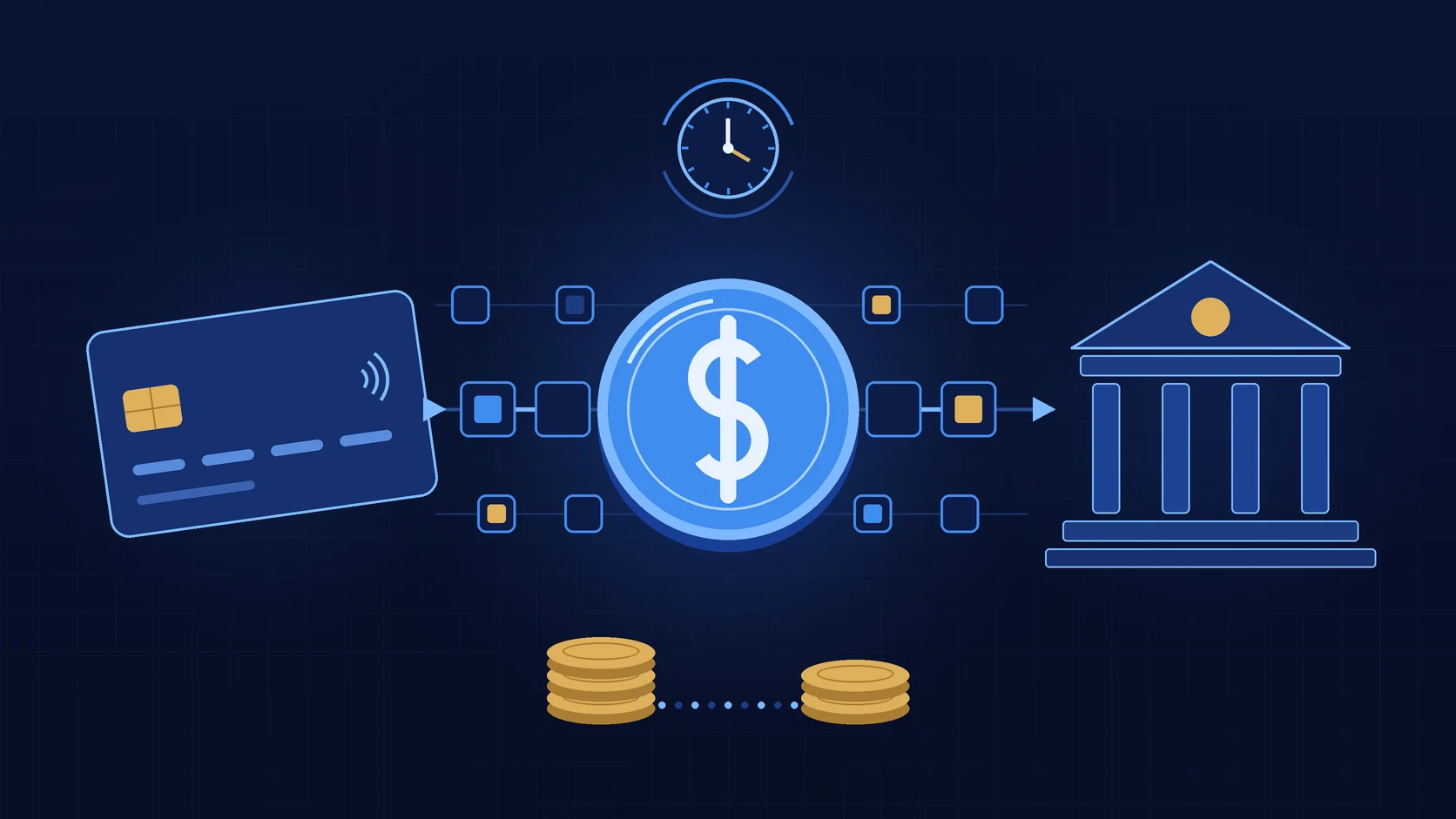
On September 22, 2026, SoFi and Mastercard announced that stablecoin settlement is live across SoFi Bank's debit and credit card program. In practice, the money owed for purchases made with those cards is now settled in SoFiUSD, the dollar stablecoin issued by the bank itself, and recorded on a blockchain. According to the companies, SoFi Bank is migrating its entire card program, which is expected to process more than US$25 billion in annualized volume. The announcement marks a change of phase: stablecoin settlement stops being a test and starts running in production, with a regulated bank on one side and one of the world's largest card networks on the other. This article explains what was announced, how the process works, what the numbers say and which risks and limits to watch. It is not investment advice.
What was announced
The joint announcement from SoFi Technologies and Mastercard, dated September 22, 2026, has four central points:
- It is in production. Stablecoin settlement is already working across the debit and credit card program of SoFi Bank, N.A., on Mastercard's global payments network.
- The whole program is being migrated. The bank said it is migrating its entire card program, with expected annualized volume above US$25 billion, to settlement in SoFiUSD.
- The stablecoin issuer is a bank. The companies present SoFi Bank as the first nationally chartered bank in the United States to issue a stablecoin used for settlement on Mastercard's network.
- Merchants do not have to change anything. According to SoFi, the merchant receives the money in a SoFi Bank account and can withdraw it in dollars at any time, at no cost.
SoFi's chief executive, Anthony Noto, said in the announcement: "In six months, SoFi and Mastercard took stablecoin settlement from an idea to a live product." On merchants, he said they "do not need to hold stablecoins, build new infrastructure or change how they operate."
For Mastercard, Sherri Haymond, global head of digital commercialization, said: "With SoFi, we're moving beyond exploration to implementation, bringing regulated stablecoin settlement into a live production environment."
Who is who
- SoFi Technologies: a US digital financial services company listed on Nasdaq. According to trade press reports based on the announcement, it has about 15.8 million members.
- SoFi Bank, N.A.: the group's bank. It holds a national charter and is supervised by the OCC, the US government agency that regulates national banks. It issues both the cards and SoFiUSD.
- Mastercard: a global payments network. It does not lend money or hold the customer's balance: it connects the banks that issue cards to the banks and companies that serve merchants, and organizes the settling of accounts between them.
- SoFiUSD: a stablecoin (a digital currency designed to always be worth 1 dollar) issued by SoFi Bank. It launched on December 18, 2025 on Ethereum and later reached Solana.
- Galileo: the SoFi group's payments technology platform, which serves other banks and fintechs.
- Big Business Banking: SoFi's platform for businesses, through which merchants receive settled funds.
What settlement is and what the stablecoin changes
When someone pays by card, two things happen at different moments. The first is authorization: within seconds, the customer's bank confirms that the purchase can go ahead. The second is settlement: the moment the money actually leaves the bank that issued the card and reaches the merchant's side.
In the traditional model, that second step relies on bank transfers that run during business hours. That is why it usually takes one to two business days and stops on weekends and holidays.
With the stablecoin, the flow described by the companies looks like this:
- The purchase stays the same. The customer uses the card as usual. Authorization still runs through the Mastercard network.
- Accounts are settled in SoFiUSD. Instead of a traditional bank transfer, SoFi Bank's obligation is paid with the stablecoin, in a transaction recorded on a blockchain.
- The blockchain never closes. Because the network runs 24 hours a day, settlement can happen at night, on weekends and on holidays.
- The merchant is paid into an account. Through Big Business Banking, the merchant receives the amount in a SoFi Bank account and can convert it to dollars at any time, at no cost, according to the bank. No crypto wallet is needed.
In short: the stablecoin stays behind the scenes. It changes the rail the money travels on between institutions, not the experience of the person buying.
Timeline
- December 18, 2025: SoFi launches SoFiUSD on Ethereum, aimed at banks, fintechs and enterprise partners.
- March 3, 2026: SoFi and Mastercard announce the partnership to use SoFiUSD as a settlement option on Mastercard's network.
- April 2, 2026: SoFi introduces Big Business Banking, a platform for businesses that uses the Solana network and supports minting and redeeming SoFiUSD.
- May 2026: SoFiUSD becomes available to members in the SoFi app, according to The Block and Genfinity.
- September 22, 2026: the companies announce that stablecoin settlement is live across SoFi Bank's card program.
Numbers to put it in perspective
| Indicator | Value | Source, period and scope |
|---|---|---|
| Card program volume | More than US$25 bn | SoFi/Mastercard announcement, Sep 22, 2026; expected annualized volume, SoFi Bank cards only |
| Time from partnership to live operation | About 6 months | Announcements of Mar 3 and Sep 22, 2026 |
| SoFiUSD in circulation | ≈ US$332.6 m | Genfinity; late Aug 2026; Solana plus Ethereum |
| SoFiUSD on Solana | ≈ US$232.6 m (≈ 70%) | Genfinity; late Aug 2026 |
| SoFiUSD on Ethereum | ≈ US$100 m (≈ 30%) | Genfinity; late Aug 2026 |
| Blockchains Mastercard supports for stablecoin settlement | 8 | The Block, Sep 22, 2026; Arbitrum, Base, Canton, Ethereum, Polygon, Solana, Tempo and XRP Ledger |
| SoFi members | ≈ 15.8 m | FinTech Global, based on the announcement; Sep 2026 |
| Accounts served by the group's technology (Galileo) | More than 134 m | FinTech Global, based on the announcement; global scope |
A simple calculation helps with scale: US$25 billion a year is about US$68 million a day, on average. The calculation is Cripto View's own (25 billion divided by 365) and is only an order of magnitude.
What the data shows and what it does not allow us to conclude
What it shows: a regulated bank has put into production the settlement of an entire card program using its own stablecoin, on a global payments network. The volume cited is significant for a single issuer, and the roughly six-month timeline suggests the necessary infrastructure already existed on both sides.
What it does not allow us to conclude:
- The US$25 billion is an annualized projection for the program, not an amount already settled in stablecoin. The companies have not disclosed how much has been settled so far.
- The figure refers only to SoFi Bank's cards. It does not measure stablecoin use across the Mastercard network as a whole, or in card payments worldwide.
- The SoFiUSD supply data comes from a trade publication and dates from late August, before the announcement. It may have changed.
- The claim of being first ("first national bank") is the companies' own and depends on the framing used: nationally chartered US banks that issue the stablecoin used for settlement.
- The announcement does not say how much the operation costs the bank or whether any savings will be passed on to customers or merchants.
What changes for each party
For cardholders: nothing visible. The purchase, the statement and the balance remain in dollars. The cardholder does not receive, pay or need to hold a stablecoin.
For merchants: the promise is faster access to funds, including outside banking hours, and withdrawals at no cost. According to SoFi, this applies to those who receive through a SoFi Bank account, via Big Business Banking.
For the issuing bank: money no longer sits idle waiting for the settlement window. The bank can settle around the clock, using an asset it issues itself.
For other banks and fintechs: since the March announcement, the plan has been for Galileo to offer SoFiUSD settlement to other card issuers. As of the date of consultation, no Galileo client had been publicly confirmed.
Why this matters for the market
- From pilot to production. For years, the use of stablecoins by financial institutions was presented as a test or as preparation. Here, an existing card program is being settled this way.
- The issuer is a supervised bank. The largest stablecoins on the market are issued by companies that are not banks. In SoFiUSD's case, the issuer is a national bank, subject to capital, liquidity and supervision rules.
- The card network becomes a rail. Mastercard already supports other regulated stablecoins for settlement, such as USDC, PYUSD and RLUSD, across eight blockchains, with intraday, weekend and holiday settlement, according to The Block. SoFiUSD joins that list.
- Public blockchains as infrastructure. Settlement takes place on open networks, such as Solana and Ethereum, rather than on a closed system run by a single bank.
- Global reach, local start. The Mastercard network is worldwide, but what is live is the program of one US bank. Expansion to other issuers, currencies and countries depends on new agreements and on the rules of each place.
Advantages and limitations
Advantages cited by the companies:
- Settlement 24 hours a day, seven days a week, without waiting for banking hours.
- Faster access to funds for merchants.
- Very low transaction costs on the blockchains used.
- No change required from buyers or sellers.
- An issuer subject to banking supervision.
Limitations:
- The benefits for merchants depend on receiving through a SoFi Bank account.
- The disclosed volume is an expectation, with no public data on what has already been settled.
- The model relies on a single issuer and a single stablecoin.
- Adoption by other banks, through Galileo, is still a plan.
- Cross-border payments and remittances are being explored, not yet operating.
Risks and precautions
- Issuer risk: according to SoFi itself, SoFiUSD is not a bank deposit, is not insured by the FDIC (the fund that guarantees deposits in the United States) or protected by SIPC, is not legal tender and may lose value. Being issued by a bank does not turn it into an account balance.
- Reserve risk: SoFiUSD is redeemable 1:1 for dollars and backed primarily by cash. Holding that peg depends on the quality and transparency of the reserves.
- Network risk: public blockchains can suffer congestion, failures or outages. A process that depends on them needs contingency plans.
- Regulatory risk: the rules for stablecoins in the United States, set by the GENIUS Act, are still being implemented, and other countries have their own rules. Changes may alter costs and conditions.
- Concentration risk: when the bank issues the card, the stablecoin and the merchant's account, several roles sit within the same institution.
- Information risk: announcements like this are often used in scams. SoFi and Mastercard do not ask for crypto deposits by message, and the news is not a signal to buy any asset.
What to watch from here
- Public data on the volume actually settled in SoFiUSD.
- How the circulating supply of SoFiUSD evolves and how it is split between networks.
- The first banks and fintechs to adopt the model through Galileo.
- Agreements with large merchants. SoFi says it is in talks with multinational retailers and technology platforms.
- Progress on cross-border payments and remittances, which the companies say they are exploring.
- Moves by other banks and other card networks in the same direction.
- The final regulation of stablecoins in the United States and other jurisdictions.
Checklist for following the topic
- Separate the announcement (what is live) from the plans (what the companies say they are exploring).
- Check whether a number is a realized value or a projection.
- Check who issues the stablecoin and which protections it does or does not have.
- Read the official announcement, not just headlines.
- Remember that settlement between institutions is not the same as paying with crypto at the checkout.
- Be wary of offers that use the companies' names to promise gains.
Frequently asked questions
Do SoFi customers now pay with a stablecoin?
No. The purchase is still made in dollars, with the usual card. The stablecoin is used afterwards, when the institutions settle accounts.
Do merchants need to accept cryptocurrencies?
No. According to SoFi, merchants do not need to hold stablecoins or change how they operate. They receive funds in a SoFi Bank account and can withdraw in dollars.
What is SoFiUSD?
It is a dollar stablecoin issued by SoFi Bank, launched in December 2025. It is redeemable 1:1 and backed primarily by cash. It is not a bank deposit and is not FDIC-insured.
Has the US$25 billion already been settled in stablecoin?
No. The figure is the expected annualized volume of SoFi Bank's card program. The companies have not disclosed the total already settled.
Does Mastercard only work with SoFiUSD?
No. According to The Block, the network supports other regulated stablecoins for settlement, such as USDC, PYUSD and RLUSD, across eight blockchains.
Does this apply worldwide?
The Mastercard network is global, but what went live is the card program of one US bank. Expansion to other issuers and countries depends on new agreements and local rules.
Is this news a reason to buy a cryptocurrency?
This article makes no recommendation. The announcement is about payments infrastructure. Stablecoins aim for price stability and are not designed to appreciate, and the use of a blockchain in a process like this does not guarantee a rise in that network's token.
Read also
- What stablecoins are: types, how the peg holds and risks
- How to use stablecoins safely: issuer, network and fees
- Stablecoins 2026: reserves, rules and risks for beginners
- Solana: what it is, advantages, risks and how to evaluate SOL
- Tokenized real-world assets: what RWAs are and what to ask before investing
Informational and educational content. It does not constitute investment advice, an offer or a solicitation to buy or sell assets.
Sources: SoFi — announcement of stablecoin settlement on Mastercard's network (Sep 22, 2026); SoFi — announcement of the partnership with Mastercard (Mar 3, 2026); SoFi — launch of SoFiUSD (Dec 18, 2025); The Block — start of settlement and stablecoins supported by Mastercard; PYMNTS — expansion plans for stablecoin settlement; FinTech Global — details of the announcement and SoFi figures; Genfinity — SoFiUSD supply by network (late Aug 2026); Yahoo Finance — launch of Big Business Banking (Apr 2, 2026); UseTheBitcoin — Galileo and talks with merchants. Consulted on Oct 3, 2026.
Read more
A sound market reading combines data, context and clear risk limits.