
What is x402? How AI agents pay with cryptocurrencies
x402 is a protocol that lets AI agents pay with crypto, such as the USDC stablecoin, for pages and APIs, with no sign-up or card. See what it is, how it works, whether there is an x402 token, what already runs and what changes for Brazil.
Short answer
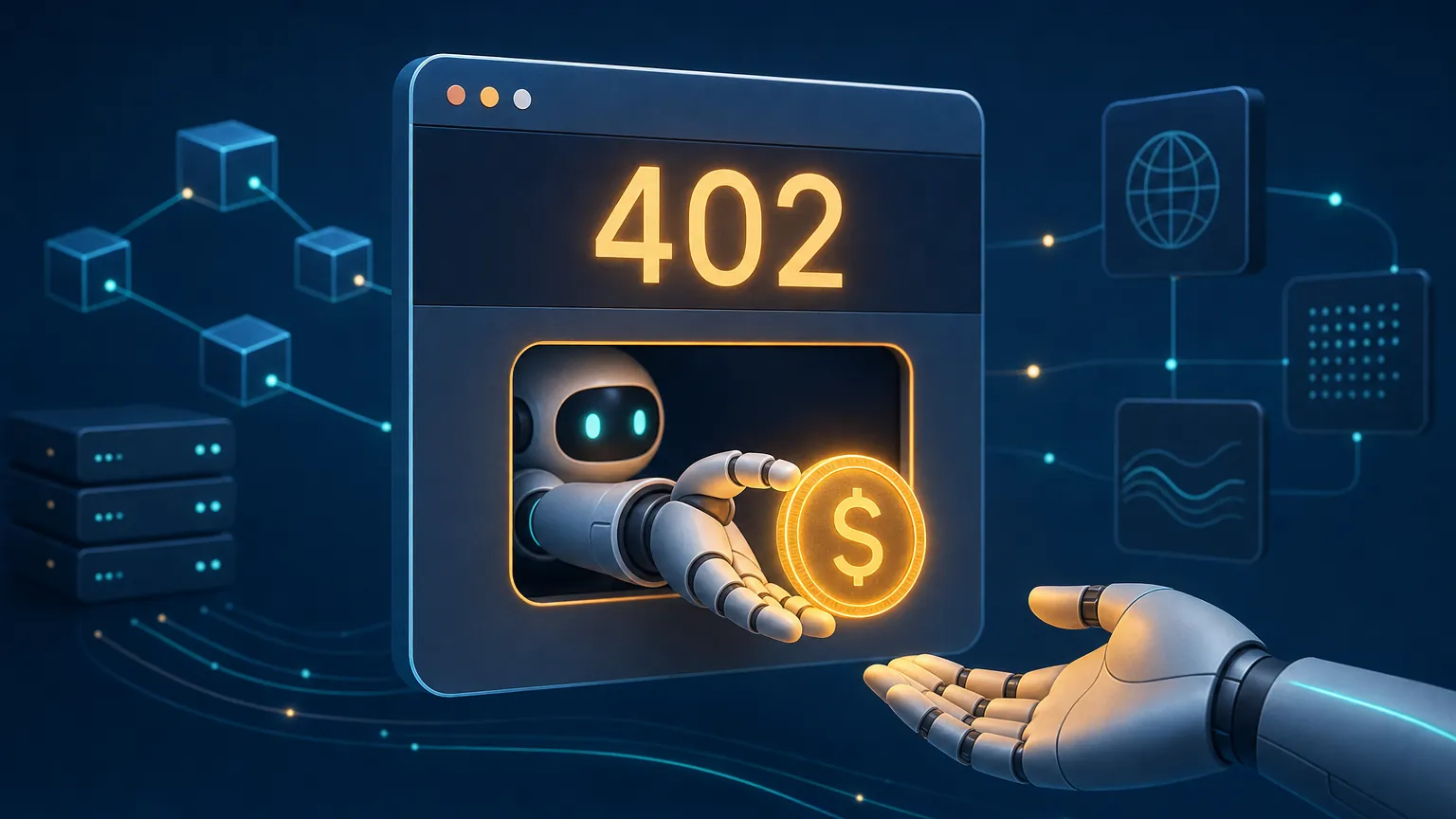
x402 is an open standard that lets programs and artificial intelligence (AI) agents pay with crypto for a page, a dataset or an API in the middle of the request itself, using the HTTP 402 "Payment Required" status code. The 402 code has been part of the web standard for decades, but it never got an official way to be used. Coinbase created x402 in May 2025, Cloudflare joined it to promote the protocol, and since July 2026 it has been stewarded by the x402 Foundation, under the Linux Foundation. Payments are usually made in stablecoins such as USDC, and the design targets AI agents, which cannot fill in sign-up forms or type a card number. The idea is real and already works technically. But the commercial products are still in beta, and the main one, Cloudflare's Monetization Gateway, only accepts sellers and buyers in the United States. This article explains what x402 is, how it works, what is already running, what is still a promise and what it means for people in Brazil. It is not investment advice.
What the 402 code is
Every time a browser asks for a page, the server answers with a three-digit code. 200 means "it worked". 404 means "page not found". 402 means "payment required".
The problem is that 402 never had usage rules. Mozilla's reference documentation (MDN) describes it as a code "reserved for future use" and says there is no standard convention: each system uses it differently. The current HTTP standard, RFC 9110, published in June 2022, kept it that way. Cloudflare itself, when it launched its first product built on the code, called it a "mostly forgotten" piece of the web.
In other words: the claim circulating on social media, that 402 was created and "never finished", has some truth to it. The code existed, but nobody defined how the payment should happen.
What x402 is
x402 is exactly that missing definition. It is a protocol, a set of rules that says how the server states the price, how the client pays and how the server confirms the payment, all inside an ordinary web request.
- Who created it: Coinbase, which introduced x402 in May 2025 as a standard for internet-native payments, aimed at APIs, apps and AI agents.
- License: it is open source. The official repository has libraries in TypeScript, Python and Go, and it was moved to the x402 Foundation's organization.
- Currency: the main use is stablecoins (digital currencies that aim to always be worth 1 dollar), above all USDC, according to Coinbase and Cloudflare. The official site says the protocol can be extended to traditional payment methods.
- Networks: according to the official site, it works on Ethereum-compatible blockchains and on Solana, among others.
- Cost: the protocol charges no fee of its own. You pay the fee of the blockchain network used. That does not mean everything is free: companies that process the payments and platforms that sell the service may charge their own fees.
How it works, step by step
The official repository describes the flow like this, simplified:
- The client asks for the resource. An AI agent, for example, requests a dataset from an API.
- The server answers 402. Along with the code, it sends the terms: how much it costs, in which currency, on which network and to which address the payment goes.
- The client signs the payment. It picks one of the options offered and repeats the request, now with the signed payment attached.
- The server checks it. Verification can be done by the server itself or by a facilitator: a service that checks that the payment is valid and records it on the blockchain. Coinbase runs a facilitator of this kind.
- The server delivers. If everything is in order, it answers 200 and returns the content, with a settlement receipt.
For the payer there is no sign-up, password, access key or card. But there is a condition: the agent needs a digital wallet with a balance. Someone, a person or a company, set up that wallet, funded it and decided how much the agent may spend. "No humans" applies to the moment of purchase, not to where the money comes from.
The protocol allows different ways to charge. The repository lists an exact price per request (exact), a price up to a maximum (upto) and batch settlement (batch-settlement). Cloudflare has also proposed a "deferred" model, in which charges are added up and settled later, for example once a day.
Who is behind it
- Coinbase: created the protocol and contributed it to the Linux Foundation.
- Cloudflare: on September 23, 2025, it announced with Coinbase the creation of the x402 Foundation and added x402 support to its toolkit for agents (Agents SDK) and to its integrations with MCP, the standard used to connect AI assistants to external tools.
- Linux Foundation: on July 14, 2026, it announced the start of operations of the x402 Foundation, with open governance and 40 organizations. Premier members include AWS, American Express, Circle (the issuer of USDC), Cloudflare, Coinbase, Google, Mastercard, Shopify, Stripe and Visa.
The arrival of card networks and payment processors signals industry interest. But joining a foundation does not mean already using the protocol in production. The Linux Foundation announcement gives no usage figures.
x402, Pay Per Crawl, Pay Per Use and Monetization Gateway: not the same thing
Cloudflare has several products tied to the 402 code, and they are often mixed up. The table summarizes each one, based on the official announcements.
| Name | What it is | How the money flows | Status (source and date) |
|---|---|---|---|
| x402 | Open protocol for per-request payments | Stablecoins on a blockchain, from payer to seller | In use; governed by the x402 Foundation (Linux Foundation, Jul 14, 2026) |
| Pay Per Crawl | Charging AI crawlers that read the site | Uses 402 with Cloudflare's own headers; Cloudflare charges the crawler and pays the site | Private beta since Jul 1, 2025 (Cloudflare blog) |
| Pay Per Use | Model running alongside Pay Per Crawl: pays for the use of content, such as in a citation, rather than for access | The buyer reports the use; Cloudflare bills it and pays the site once a month | Beta since Sep 30, 2026, no general availability date (Cloudflare blog) |
| Monetization Gateway | Charging for pages, APIs, data and AI tools via x402 | USDC on the Base network, verified by Coinbase's facilitator | Closed beta since Sep 30, 2026, only for US sellers and buyers; fees not disclosed (Cloudflare blog) |
One important point: Pay Per Crawl is not x402. It uses the 402 code, but with Cloudflare's own rules and billing, with the company acting as the payment intermediary. Pay Per Use does not say it uses x402 either. Only the Monetization Gateway settles through the protocol.
Why this is happening now
The pressure comes from bots. According to Cloudflare, 52% of the crawler requests the company identified on its own network in June 2026 were for training AI models, up from 22% in spring 2025. The same report says more than half of internet traffic is no longer human.
For publishers, this creates a problem: bots read the pages but rarely send visitors back. That is why, since September 15, 2026, Cloudflare blocks training and agent crawlers by default on pages that display ads, for new domains joining the platform. Search crawlers remain allowed, but those that do search and training at the same time, such as Googlebot, follow the most restrictive rule and may end up blocked. Site owners can change this setting.
x402 enters this picture as an alternative to simply blocking: instead of banning the bot, the site can charge it.
What works today and what is still a promise
What already works:
- The protocol is published, open and has ready-made libraries in several languages.
- A developer can add x402 to their own API and get paid in stablecoins, without depending on Cloudflare.
- Cloudflare has real customers in the Monetization Gateway beta, such as Ceramic.ai, Stocktwits and API2PDF, according to the September 30, 2026 announcement.
What is still a promise:
- Cloudflare's commercial products are in beta, with no published price and no general availability date.
- The Monetization Gateway is limited to the United States. The company says other regions are "on the way", with no timeline.
- For a site to earn money, there has to be an agent on the other side with a wallet, a balance and permission to pay. That audience is still small.
- There are no official, independent usage figures. Transaction numbers circulating online come from interested companies or secondary sources, and part of the activity may be testing. That is why this article does not use them.
"Agents will pay you every time they visit your site"?
Not quite. Three conditions have to be met:
- The site owner has to turn on charging. Nothing happens on its own. You have to set up x402 on the server or join a service such as the Monetization Gateway.
- The visitor has to be an agent that pays. People and most bots do not pay. Whoever does not pay simply cannot access the paid content.
- The amounts are small. Cloudflare's announcement talks about paying a specialized API "a fraction of a cent" per task. It takes a lot of volume to make a difference.
There is also a hidden cost: charging can push away the search and AI answer bots that cite the site and send readers. For small sites that depend on being found, blocking or charging can cost more than it earns.
What this means for Brazil
- Cloudflare's product is not available. The Monetization Gateway beta is only for US sellers and buyers. A Brazilian site cannot use it today.
- The protocol is open. A developer in Brazil can implement x402 on their own. In that case, though, they receive stablecoins in a wallet and have to handle conversion, safekeeping and reporting.
- There are Central Bank rules. Central Bank of Brazil Resolutions 519, 520 and 521, published on November 10, 2025 and in force since February 2, 2026, regulate virtual asset service providers and treat part of the operations with these assets as foreign exchange. Receiving stablecoins from payers abroad may fall under these rules. The details are in our guide to Brazil's Central Bank rules for exchanges and self-custody wallets.
- Tax and accounting. Income received in crypto is still income. Before charging in stablecoins, talk to an accountant about taxation and how to report it.
- For the ordinary reader, nothing changes for now. x402 is made for programs, not people. Nobody needs a crypto wallet to keep reading websites.
Is there an x402 token?
There is no official x402 token. The protocol has no currency of its own: payments use stablecoins that already exist, such as USDC. The announcements from Coinbase, Cloudflare and the Linux Foundation and the protocol's official site mention no token issued by x402 or by the x402 Foundation.
Even so, anyone searching for "x402 token" finds lists of coins. CoinGecko keeps a category called "x402 Ecosystem", which groups tokens from projects it associates with the theme. On November 7, 2026, the three largest in the category by market value were Chainlink, Unibase and EigenLayer. Being on that list does not mean the project is part of the protocol, or that the token will rise in value because of it. Trendy names are often used to attract buyers.
Risks and precautions
- Stablecoin risk: payment is made in a currency issued by a private company. It aims to be worth 1 dollar, but it depends on the issuer's reserves and soundness. See what stablecoins are and their risks.
- Security risk: an agent with its own wallet can spend more than expected through error, a programming bug or an attack. Limit the balance and the spending per operation.
- Counterparty risk: facilitators and intermediary platforms can go offline, change rules or charge fees.
- Regulatory risk: rules for payments with virtual assets are changing in Brazil and abroad.
- Scam risk: be wary of any "x402 token" or promise of gains tied to the protocol. x402 is a technical standard, not an asset to buy.
Checklist for following the topic
- Separate the protocol (x402) from the products that use it (such as the Monetization Gateway).
- Check whether a product is in beta, on a waitlist or available to everyone, and in which countries.
- Check whether a usage figure comes from an independent source or from the company itself.
- Remember that getting paid in stablecoins requires a wallet, conversion and reporting.
- Weigh what you gain by charging against what you lose in visibility on search engines and AI assistants.
- Be wary of offers that use the x402 name to promise profit.
Frequently asked questions
Is x402 a cryptocurrency or a token?
No. It is a protocol, a set of technical rules. Payments use existing stablecoins such as USDC. There is no official x402 token to invest in.
Who created x402?
Coinbase, in May 2025. In 2026 the protocol was contributed to the x402 Foundation, under the Linux Foundation, whose members include Cloudflare, Google, Visa, Mastercard and Stripe.
Do I need a crypto wallet to browse the internet now?
No. x402 was made for programs and AI agents. People keep accessing websites as usual.
Can a Brazilian site charge AI agents today?
Not through Cloudflare's Monetization Gateway: the beta is US-only. Implementing the protocol on your own is technically possible, but the site gets paid in stablecoins and has to follow the Central Bank and tax authority rules.
Does Cloudflare's Pay Per Crawl use x402?
No. It uses the 402 code, but with Cloudflare's own headers and billing. The company's product that settles through x402 is the Monetization Gateway.
Is x402 free?
The protocol charges no fee. But there is the blockchain network fee, and facilitators and platforms may charge for their services.
Is this news a reason to buy any cryptocurrency?
This text makes no recommendation. x402 is payment infrastructure. The use of a network or a stablecoin by the protocol does not guarantee that any asset will rise in value.
Informational and educational content. It does not constitute investment advice, an offer or a solicitation to buy or sell assets.
Sources: MDN — 402 Payment Required status code; IETF — RFC 9110, HTTP Semantics (Jun 2022); Coinbase — launch of x402 (May 2025); GitHub — x402 repository; x402.org — official site; Cloudflare — x402 Foundation with Coinbase (Sep 23, 2025); Linux Foundation — operational launch of the x402 Foundation (Jul 14, 2026); Cloudflare — Pay Per Crawl (Jul 1, 2025); Cloudflare — Monetization Gateway announcement (Jul 1, 2026); Cloudflare — Monetization Gateway beta (Sep 30, 2026); Cloudflare — Pay Per Use (Sep 30, 2026); Cloudflare — new default rules for AI bots (Jul 1, 2026); Cloudflare — report on bots and the agentic internet (Jul 1, 2026); Central Bank of Brazil — Resolutions 519, 520 and 521; Central Bank of Brazil — Resolution BCB 520; CoinGecko — x402 Ecosystem category (Nov 7, 2026). Consulted on Nov 7, 2026.
Read more
- What stablecoins are: types, how the peg holds and risks
- SoFi and Mastercard put stablecoin settlement into operation
- Stablecoins and new rules: why price stability is not a safety guarantee
- Ledger Agent Stack: AI can prepare a transaction, but it should not hold your key
- How cryptocurrencies are used in the real world today
- Stablecoins 2026: reserves, rules and risks for beginners
A sound market reading combines data, context and clear risk limits.