
Strategy and Twenty One Capital: the largest companies holding Bitcoin today
Strategy holds 848,517 BTC and Twenty One Capital 43,514 BTC. See the numbers with dates and sources, how each funds its purchases and the risks of holding Bitcoin as company cash.
Quick answer
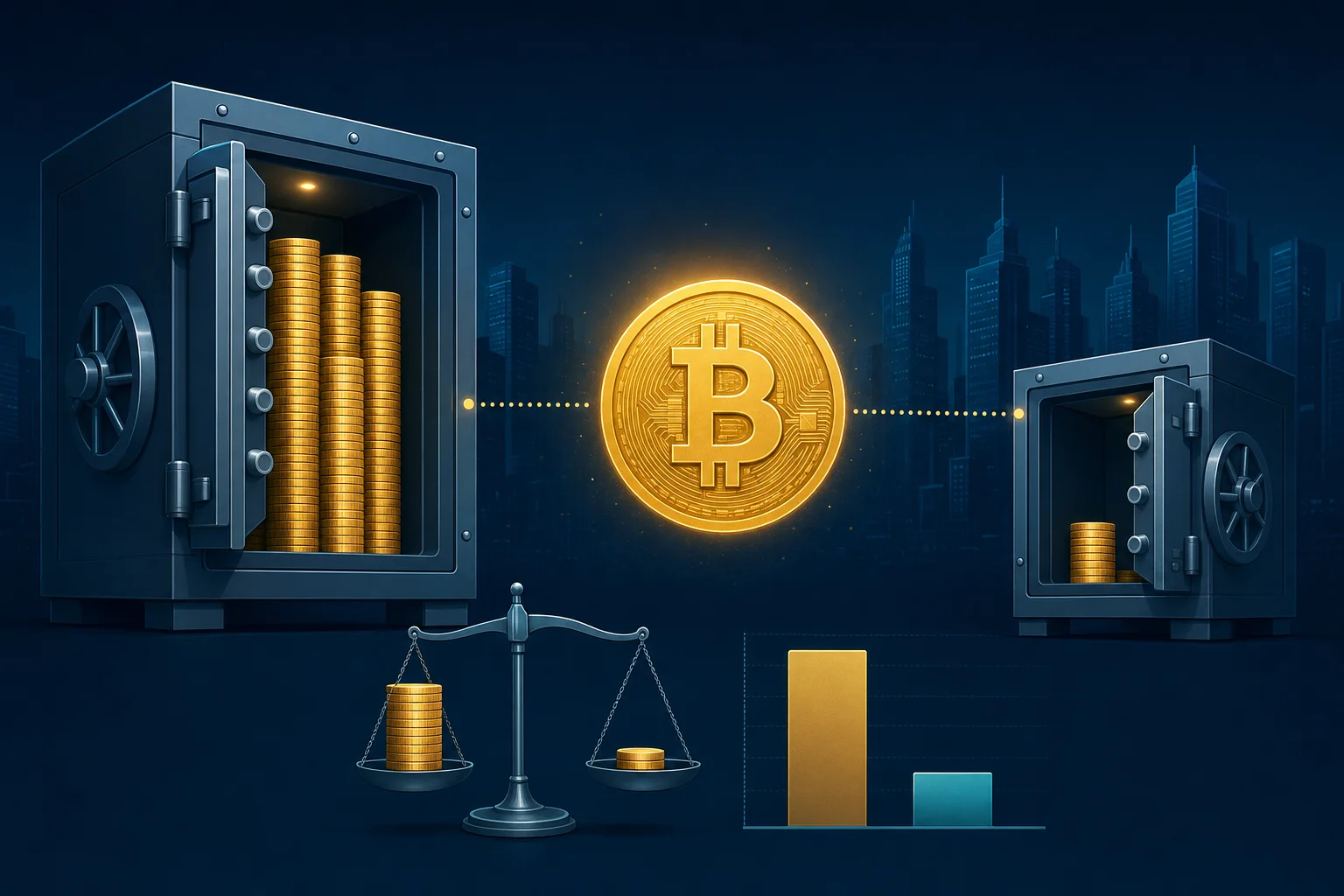
Strategy (formerly MicroStrategy) is, by a wide margin, the largest publicly listed company holding Bitcoin: according to the report it filed with the SEC (the US securities regulator) on October 26, 2026, it held 848,517 BTC on October 25, about 4% of all the bitcoin that can ever exist (the cap is 21 million). Twenty One Capital (NYSE: XXI) is among the largest, with 43,514 BTC on June 30, 2026, the most recent position the company has published. That is about 5% of what Strategy holds (comparing different dates).
There is an important caveat about second place. Japan's Metaplanet reported 44,000 BTC on September 30, 2026, slightly more than Twenty One, but from a date three months later. Because the dates differ, this article does not say who holds second place today. It shows the numbers, the date of each one, how this type of company works and what risks it carries.
This is educational content. It does not recommend buying these companies' shares or Bitcoin. Data was checked on October 29, 2026.
Scope: who is in and who is out
This comparison covers publicly listed companies, worldwide, that disclose how much Bitcoin they hold on their balance sheets. Left out:
- Private companies, such as Tether, which issues the USDT stablecoin and controls Twenty One. Without a standard public report, there is no verifiable number.
- Bitcoin ETFs, which are funds, not operating companies. See the difference in crypto ETFs for beginners.
- Governments and individual wallets.
The numbers below come from the companies' own reports, each with its own date. They are not a simultaneous snapshot of the market: comparing a position from October 25 with one from June 30 requires care.
The numbers in one table (not a ranking)
| Company | Bitcoin held | Position date | Source |
|---|---|---|---|
| Strategy (MSTR) | 848,517 BTC | Oct 25, 2026 | 8-K report to the SEC, Oct 26, 2026 |
| Metaplanet (Tokyo) | 44,000 BTC | Sep 30, 2026 | CoinDesk, Oct 5, 2026, on the company's disclosure |
| Twenty One Capital (XXI) | 43,514 BTC | Jun 30, 2026 | 10-Q quarterly report to the SEC |
| MARA Holdings (MARA) | 35,577 BTC | Jun 30, 2026 | 10-Q quarterly report to the SEC |
Other large companies exist, such as Strive, but the counts published by tracking sites differ from one another and were not confirmed in a report from the company itself. For that reason they are not in the table. MARA is included because it has a figure confirmed in a filing, but it is a miner, not a company created to hold Bitcoin.
What is a Bitcoin treasury company
A treasury is the cash a company keeps to protect itself and pay its bills. Most hold dollars, government bonds or low-risk investments. A Bitcoin treasury company chooses to hold a significant part of that cash, or all of it, in Bitcoin. People who buy its shares gain indirect exposure to Bitcoin's price, but that is not the same as owning Bitcoin: the share also depends on the company's debt, on the price the market pays for it and on the decisions of its managers.
To grasp the size of a position, recall market capitalization: the total value of a company or asset is price times quantity. A position of 848 thousand bitcoin weighs more or less depending on the day's price.
Strategy: the largest, and how it funds its purchases
Strategy (formerly MicroStrategy) is a software company that began buying Bitcoin systematically in 2020. According to the October 26, 2026 report, the 848,517 BTC position was bought for US$ 64.02 billion, or about US$ 75,446 per bitcoin, including fees and expenses. At Bitcoin's price of US$ 80,747 on October 29 (CoinGecko), the position would be worth about US$ 68.5 billion, our own calculation, which changes every day.
How does a software company raise so many billions? The October 19 report shows the mechanism at small scale: in the week of October 12 to 18, Strategy bought 267 BTC (US$ 22.1 million) using US$ 22.0 million from shares sold on the market, in a program called at-the-market (ATM), in which the company sells shares gradually at the day's price. The following week, October 19 to 25, it neither bought nor sold any Bitcoin.
The second-quarter report (published July 30, 2026) shows the full picture:
- Between April and June it bought 85,296 BTC for US$ 6.42 billion, largely funded by preferred shares called STRC, which pay periodic dividends (a rate of 11.5% through June and 12.0% from July). STRC alone raised US$ 5.47 billion in the quarter.
- It paid US$ 400.7 million in preferred dividends in the quarter.
- It sold 1,395 BTC (US$ 83.2 million) to pay those dividends.
- It recorded a net loss of US$ 8.22 billion, almost all of it an unrealized accounting loss, because Bitcoin is recorded at market value at the end of the quarter: the price was around US$ 58.6 thousand on June 30.
- In May it repurchased US$ 1.5 billion (principal amount) of convertible debt, paying about US$ 1.38 billion in cash and reducing that debt's principal from US$ 8.21 billion to US$ 6.71 billion.
To get through bad periods without selling Bitcoin, Strategy keeps a dollar reserve: US$ 4.83 billion on October 18. On October 28, its shareholders approved, based on preliminary results, a change to daily dividends on its preferred shares (starting November 1, 2026 for STRC).
Twenty One Capital: born to hold Bitcoin
Twenty One was created in 2025 with backing from Tether, Bitfinex (an exchange in the same group) and Cantor Fitzgerald. It began trading on the New York Stock Exchange in December 2025 through a merger with a SPAC (Cantor Equity Partners), a type of company created solely to take another one public. Its June 30, 2026 quarterly report shows:
- 43,514 BTC, valued at US$ 2.55 billion on that date, at US$ 58,605 per bitcoin. At the October 29 price, the same quantity would be worth about US$ 3.5 billion: the same position, very different values within four months.
- Convertible note debt with a carrying balance of US$ 484.5 million (1.0% interest, due 2030), with about 16,116 BTC pledged as collateral, roughly 37% of the position.
- A net loss of US$ 413.5 million in the second quarter and US$ 1.27 billion in the half year.
The company changed leadership in July 2026. Jack Mallers, founder and then chief executive, resigned as CEO and director effective July 20, and returned to Strike, his Bitcoin payments company. Raphael Zagury took over as CEO. The company said it is no longer considering the acquisition of Strike. In May, Tether bought SoftBank's stake and remained the majority shareholder. The report describes the company as focused on Bitcoin-related businesses: accumulating and managing BTC, producing educational content and, subject to regulatory approval, launching financial services.
We did not find, in a primary source, a Twenty One position later than June 30, 2026. That is why the number appears with that date.
Who else appears on this list
Metaplanet. The Japanese company reached 44,000 BTC on September 30, 2026, at an average cost of about US$ 98,454 per bitcoin. In the quarter it sold 10,000 BTC (US$ 789.2 million) and repurchased 11,000 (US$ 948.7 million), a transaction that, according to CoinDesk, was meant to show the company can turn part of its holdings into cash. The company kept the money temporarily in cash, without repaying its interest-bearing debt, and then bought Bitcoin back at a higher price.
MARA. A publicly listed miner, it held 35,577 BTC on June 30, 2026, versus 53,822 BTC at the end of 2025. According to its 10-Q, it sold Bitcoin in the half year to fund operations, growth and liquidity, and in the same period repurchased about US$ 1 billion of debt. The report does not link the two. Of the 35,577 BTC, 9,270 were loaned out or pledged as collateral. This shows that having Bitcoin on a balance sheet is not the same as having it available.
What the data shows and what it does not allow us to conclude
It shows: Strategy concentrates a huge share (about 4% of the 21 million cap) in a single company; the others are an order of magnitude lower; and this type of company can both buy and sell Bitcoin.
It does not allow us to conclude:
- Who is in second place today: the dates and methodologies differ.
- That these shares are a good or bad investment. A share price reflects debt, dividends, market premium or discount and expectations, not just Bitcoin.
- That these companies' positions make Bitcoin's price rise or fall. They are large, but the price is set by the market as a whole.
- Anything about Tether or ETFs, which are outside the scope.
Risks and precautions
- Market risk. Bitcoin fell about 40% between the January peak and the June low of 2026, on daily closes (see Bitcoin in 2026: the year's change). Companies with a balance sheet concentrated in one asset feel this directly in their results.
- Funding risk. Strategy depends on selling shares and preferred shares to buy more Bitcoin and pay dividends. If the market closes that door, it may have to sell Bitcoin, as it did in the second quarter.
- Debt and collateral risk. Part of Twenty One's Bitcoin is loan collateral. Pledged collateral is not free to use.
- Governance risk. The CEO change at Twenty One and the shifts in plans show that strategy can change.
- Counterparty and custody risk. Whoever buys the share does not control where the Bitcoin is or who holds it. Compare with self-custody, where you hold the keys.
- Information risk. Tracking sites disagree. Prefer the company's own report.
Checklist for beginners
- Look up the date of each position before comparing two companies.
- Check the number in the company's own report (8-K or 10-Q, on the SEC website), not just on aggregators.
- See how much of the position is pledged or loaned out.
- Understand how the company pays dividends and debt: with cash, share sales or Bitcoin sales.
- Remember that a share is not Bitcoin: one's price can drift from the other's.
- Never invest based on a ranking. Define your plan first (see risk and discipline).
Frequently asked questions
How much Bitcoin does Strategy hold?
848,517 BTC on October 25, 2026, bought for about US$ 64.02 billion, according to the October 26 8-K report. The position changes when the company buys or sells, and it discloses the numbers weekly.
Which is the second-largest company holding Bitcoin?
It cannot be stated with confidence. Metaplanet reported 44,000 BTC on September 30 and Twenty One 43,514 BTC on June 30. The dates differ and the gap is small.
Does Tether own Twenty One Capital?
Tether is the majority shareholder, according to the quarterly report and the press, but Twenty One is a publicly listed company on the New York Stock Exchange with other shareholders. Tether itself is private and outside this comparison.
Is buying Strategy shares the same as buying Bitcoin?
No. The share reflects the Bitcoin the company holds, but also its debt, preferred dividends and the market's mood about the company. It can rise or fall differently from Bitcoin.
Why did Strategy sell Bitcoin if it is an accumulation company?
In the second quarter of 2026 it sold 1,395 BTC to pay preferred dividends, according to its report. It shows that even a company that advocates holding Bitcoin long term may sell when it needs cash.
Read also
Bitcoin: origin, evolution and use; Market capitalization; Crypto ETFs for beginners; Bitcoin in 2026: the year's change; Self-custody in 2026.
Sources: Strategy, 8-K report of Oct 26, 2026; Strategy, 8-K of Oct 19, 2026; Strategy, Q2 results (Jul 30, 2026); Strategy, 8-K of Oct 28, 2026; Twenty One Capital, Q2 2026 10-Q; The Block: Jack Mallers leaves Twenty One (Jul 21, 2026); CoinDesk: Metaplanet (Oct 5, 2026); MARA Holdings, Q2 2026 10-Q; CoinGecko: Bitcoin price. Checked on Oct 29, 2026. Informational and educational content; it is not investment advice, an offer or a solicitation to buy or sell assets.
Read more
A sound market reading combines data, context and clear risk limits.