
Tether: The Company Behind USDT, Business Model and Risks
Understand who Tether is, how USDT reserves work, why the company makes billions from US Treasuries, its attestation track record, and counterparty risks.
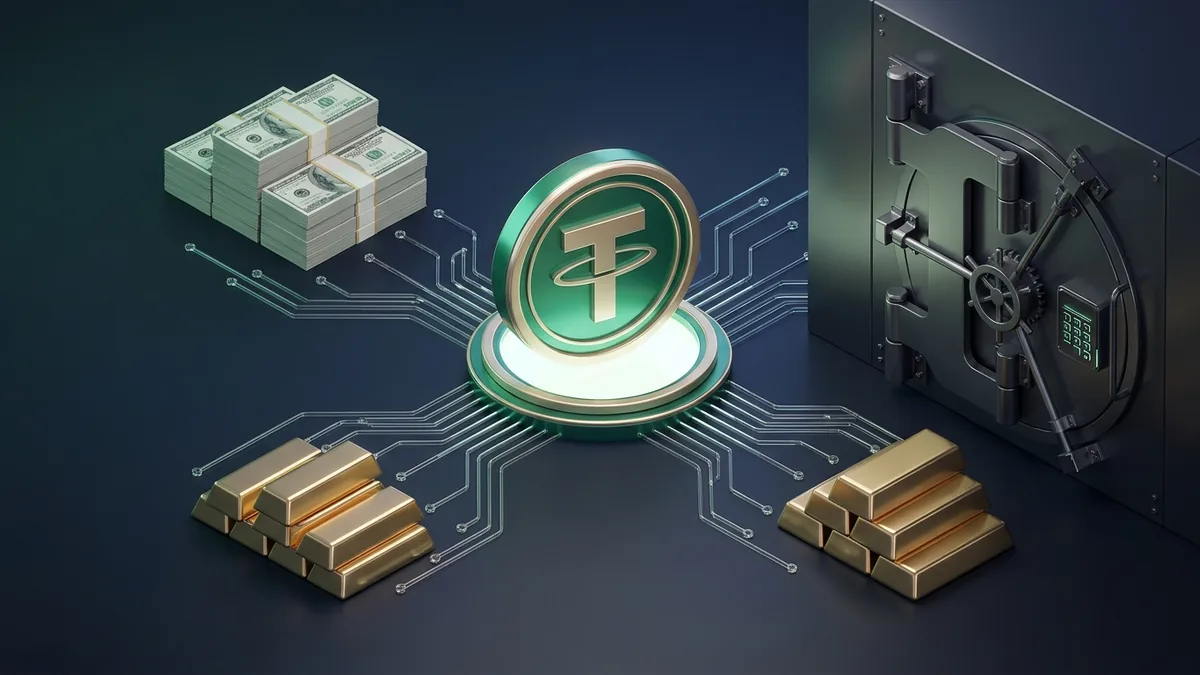
Direct answer: what Tether is and what it does
Tether (officially Tether Operations Limited, controlled by Tether Holdings Limited) is the company behind USDT, the largest and most widely traded stablecoin in the digital asset market. Founded in 2014, the company issues digital tokens designed to maintain a 1:1 economic peg with the US dollar (1 USDT = $1.00).
While USDT serves as the primary currency pair and liquidity backbone across crypto exchanges worldwide, Tether is not a regulated commercial bank, its reserves carry no government deposit insurance (such as FDIC in the United States or FGC in Brazil), and everyday retail investors cannot redeem tokens directly with the company. Understanding who controls Tether, how it generates multi-billion-dollar profits, what backs its reserves, and which counterparty risks exist is essential for anyone holding digital dollars.
Origins, ownership and leadership: who runs Tether
The project started in 2014 under the name Realcoin, co-founded by Brock Pierce, Reeve Collins, and Craig Sellars in California, originally operating on the Bitcoin blockchain via the Omni Layer protocol. Later that year, it was rebranded as Tether. Shortly thereafter, its management and ownership became closely tied to the Bitfinex crypto exchange under parent holding company iFinex Inc., based in the British Virgin Islands.
Tether's leadership has historically centered on a small executive team:
- Giancarlo Devasini: Chief Financial Officer (CFO) and primary controlling shareholder, widely recognized as the group's chief financial strategist.
- Paolo Ardoino: Chief Executive Officer (CEO) since December 2023. Previously serving as Chief Technology Officer (CTO), Ardoino has long been the primary public face representing Tether to the industry and global regulators.
- Jean-Louis van der Velde: Former long-serving CEO of both Tether and Bitfinex, who transitioned into an advisory and institutional relations role.
Tether operates through an offshore corporate structure primarily incorporated in the British Virgin Islands, alongside operational and strategic entities in Lugano (Switzerland) and El Salvador.
How USDT creation and redemption work
To understand USDT, one must distinguish between the primary market (where Tether interacts directly) and the secondary market (where everyday investors trade):
- Primary market (institutional): Only pre-approved institutional entities — such as designated market makers, proprietary trading firms, and major exchanges — deal directly with Tether. To issue new tokens, the institution deposits real fiat US dollars into Tether's partner bank accounts. Once cleared, Tether mints an equivalent amount of USDT on the specified blockchain. When an institution redeems, it returns USDT tokens, Tether burns (destroys) them from circulating supply, and wires fiat USD back to the client's bank account. The minimum threshold for direct issuance or redemption is $100,000, subject to verification and fees.
- Secondary market (retail and traders): Over 99% of cryptocurrency users acquire and trade USDT on centralized exchanges (like Binance, OKX, Coinbase, or Kraken) or decentralized protocols (such as Uniswap or Curve). In this marketplace, the dollar peg fluctuates dynamically based on supply and demand among participants. Retail users do not hold direct redemption rights with Tether; their exit liquidity relies entirely on secondary market markets.
USDT circulates across multiple blockchains. The two dominant chains are Tron (TRC-20) — heavily utilized for low-cost peer-to-peer transfers, cross-border remittances, and retail commerce — and Ethereum (ERC-20) — the benchmark for decentralized finance (DeFi) collateral and institutional settlement. Significant supply also exists on Solana, TON, Avalanche, and Arbitrum.
The business model: how Tether makes billions
A natural question for newcomers is: if Tether must hold one dollar for every token issued, how does it rank among the most profitable financial companies on earth?
The business model is straightforward and extraordinarily profitable, driven by reserve yields:
- Zero-cost capital inflows: When institutions deposit cash to receive USDT, Tether pays no interest or yield to token holders. For the end user, USDT is a transactional medium and digital dollar equivalent, not an interest-bearing account.
- Investment in short-term US Treasury Bills: Tether deploys the bulk of its massive cash reserves (exceeding $120 billion) into ultra-safe, short-dated US government debt (Treasury Bills with maturities under 90 days) and overnight reverse repo facilities.
- High benchmark interest rates: With US risk-free yields hovering between 4% and 5%+ annually, a $100B+ Treasury portfolio generates between $5 billion and $7 billion in virtually risk-free gross interest income every single year.
- Lean corporate overhead: Unlike global commercial banks that employ tens of thousands of staff across brick-and-mortar branch networks, Tether operates with roughly one hundred employees. This produces unmatched net income per employee across the global financial sector.
Tether has reinvested these surplus operational profits into corporate equity (excess reserves) and diversified initiatives, including renewable-powered Bitcoin mining, artificial intelligence data center infrastructure (via Northern Data), green energy production, and peer-to-peer encrypted communications.
Reserve composition: what actually backs USDT?
Tether's reserve breakdown has transformed dramatically over time. In earlier years, the company held private corporate debt (commercial paper). Following intense market scrutiny and regulatory settlements, Tether completely eliminated commercial paper, shifting almost entirely into US sovereign debt and cash equivalents.
| Reserve Component | Approximate Share | Role and Risk Profile |
|---|---|---|
| US Treasury Bills (T-bills) | 75% to 85% | Direct short-term sovereign debt backed by the US government; provides core liquidity and risk-free interest income. |
| Overnight Reverse Repo and Money Market Funds | 5% to 10% | Daily collateralized facilities with major banking counterparties and regulated institutional cash funds. |
| Cash and Bank Deposits | 1% to 3% | Immediate fiat liquidity held across international banking partners for ongoing institutional client wires. |
| Physical Gold and Bitcoin | 5% to 10% | Physical gold bars stored in Swiss vaults, alongside Bitcoin accumulated from operating profits as strategic capital reserves. |
| Secured Loans and Other Investments | 1% to 4% | Short-term overcollateralized loans to vetted institutional clients and non-core venture stakes. |
Crucially, Tether maintains a pool of excess reserves (corporate equity beyond 100% token liabilities), intended to absorb market volatility in non-pegged assets like Bitcoin and physical gold without impairing USDT's dollar backing.
BDO attestations vs. full financial audits
The distinction between an independent attestation and a comprehensive financial audit remains a central discussion point:
- BDO Italia quarterly attestations: Since 2022, the Italian member firm of BDO (one of the world's leading accounting networks) conducts quarterly attestations on Tether's Consolidated Reserves Report (CRR). An attestation certifies that, at a specific snapshot in time on the quarter's closing date, the assets reported by management were verified and exceeded token liabilities.
- What a full audit entails: A comprehensive financial audit (under full GAAP or IFRS standards) examines the full year of operational cash flows, internal IT controls, counterparty solvency, contingent legal liabilities, and corporate ownership depth.
- Why Big Four accounting firms do not audit offshore crypto issuers: The "Big Four" accounting firms (PwC, Deloitte, EY, KPMG) have historically declined full audit engagements for offshore stablecoin issuers due to reputational risks, uncertain cross-border crypto regulations, and stringent compliance exposure.
Regulatory history and past settlements
Tether's history involves significant regulatory enforcement actions concerning past disclosure practices:
- New York Attorney General settlement (NYAG, 2021): An inquiry concluded that between 2017 and 2018, USDT was not fully backed by fiat reserves at all times. In particular, approximately $850 million belonging to Bitfinex was seized or frozen at Panamanian payment processor Crypto Capital Corp, prompting an intra-company credit facility between Tether and Bitfinex. Tether and Bitfinex settled with the NYAG without admitting wrongdoing, paying an $18.5 million penalty, barring New York residents from their platforms, and committing to regular transparency reports.
- CFTC enforcement order (2021): The Commodity Futures Trading Commission levied a $41 million penalty against Tether regarding past statements that USDT was 100% backed exclusively by fiat dollars held in bank accounts at all times from 2016 through 2018.
- Post-settlement reforms: Tether subsequently overhauled its reserve management, eliminated private debt paper, published quarterly BDO reports, and established proactive relationships with international law enforcement.
Tether's systemic role in global liquidity and emerging markets
USDT is not merely one stablecoin among many; it is the fundamental currency pair of the entire digital asset trading landscape. The vast majority of trading volume on global exchanges occurs in USDT pairs (such as BTC/USDT and ETH/USDT), far exceeding direct fiat banking volume.
Beyond speculative trading, USDT has become a vital economic tool across emerging economies facing hyperinflation, severe local currency depreciation, or restrictive capital controls (such as Argentina, Turkey, Nigeria, and parts of Southeast Asia). In these regions, individuals and small businesses use USDT as a accessible synthetic digital dollar to protect purchasing power, settle international commerce, and receive remote worker payments without traditional banking frictions.
Address freezing capabilities and regulatory divergence
Unlike censorship-resistant native cryptocurrencies like Bitcoin, USDT's smart contract includes centralized administrative controls:
- Law enforcement blacklisting: Tether actively cooperates with global law enforcement agencies, including the US Department of Justice (DOJ), the FBI, the US Secret Service, and OFAC. When an address is implicated in illicit financing, ransomware attacks, exchange exploits, or international sanctions, Tether can blacklist the address on-chain, freezing the USDT balance permanently.
- European MiCA regulation: The European Union's Markets in Crypto-Assets (MiCA) regulation instituted strict rules for Electronic Money Tokens (EMTs), requiring EU banking licenses, strict capital buffers, and reserve custody in European credit institutions. Because Tether has chosen not to pursue full EU EMT licensing, European-regulated exchanges have increasingly restricted or delisted USDT for European Union retail customers, favoring compliant alternatives like Circle's USDC or EURC.
- Regulatory developments in Brazil and Latin America: Central banks and tax agencies closely monitor stablecoin flows. In Brazil, stablecoins represent the largest share of reported digital asset volumes, prompting regulatory frameworks from the Central Bank of Brazil (BCB) focusing on asset segregation and local VASP licensing.
Key risks for USDT users
While USDT has maintained its liquidity through severe market cycles, holding it carries distinct structural risks:
- Institutional counterparty risk: Holding USDT makes you an unsecured creditor of Tether Operations Limited. In the event of catastrophic corporate insolvency or banking freezes, retail token holders lack direct claims or preferred creditor status.
- Zero deposit insurance: Stablecoins do not qualify for government-backed deposit insurance schemes. If the issuer fails, there is no public safety net.
- Secondary market depeg risk: During moments of extreme industry panic or mass redemption pressure, secondary exchange prices can temporarily slip below $1.00, potentially impacting traders who need immediate exits.
- Regulatory delisting risk: Stricter jurisdictions (like the EU under MiCA) may restrict access to USDT on regulated platforms, reducing liquidity options in certain geographies.
- Network and operational user error: Sending USDT to an incompatible network address (such as TRC-20 to an ERC-20-only address) can lead to permanent loss of funds.
Beginner's checklist for handling USDT
- [ ] Always verify the network: Ensure that the receiving wallet or exchange supports the exact network you are sending from (TRC-20, ERC-20, Solana, etc.).
- [ ] Avoid treating stablecoins as insured bank accounts: USDT is a powerful transactional tool, but it carries issuer risk that traditional insured bank deposits do not.
- [ ] Watch out for fake contract tokens on DEXs: Anyone can create a scam token called "USDT" on decentralized platforms. Always verify the authentic smart contract address.
- [ ] Remember that USDT pays no native yield: If a third-party platform offers double-digit yield on USDT, that yield comes from platform lending risk, not from Tether itself.
- [ ] Diversify cash allocations: For substantial capital reserves, holding multiple stablecoin issuers or regulated cash instruments reduces single-issuer dependency.
Frequently asked questions (FAQ)
Who owns Tether?
Tether is owned by parent holding company iFinex Inc., which also controls the Bitfinex exchange. Key controlling figures and decision-makers include CFO Giancarlo Devasini and CEO Paolo Ardoino.
Does Tether have a full financial audit?
No. Tether publishes independent quarterly attestations conducted by BDO Italia confirming that assets exceeded liabilities on the snapshot date. It does not undergo a full annual GAAP/IFRS audit by a "Big Four" accounting firm.
Can Tether freeze my USDT balance?
Yes. USDT smart contracts contain administrative functions that enable Tether to blacklist specific wallet addresses, freezing token movements upon request from legal and law enforcement authorities.
How does Tether earn billions if USDT is pegged at $1?
Tether collects fiat deposits at zero interest and invests them in short-term US Treasury Bills and cash instruments. With elevated US benchmark rates, a portfolio exceeding $100 billion generates billions of dollars in annual interest income for the company.
Is USDT backed or guaranteed by the US government?
No. While Tether holds US Treasury Bills issued by the United States government as reserve assets, the USDT tokens held by users are private corporate obligations of Tether without any government guarantee or deposit insurance.
Sources: Tether — Official Transparency & BDO Reports; New York Attorney General (NYAG) — Bitfinex and Tether Settlement (2021); CFTC — Order Imposing Civil Monetary Penalty on Tether (2021); Bank for International Settlements (BIS) — Annual Economic Report 2026; European Banking Authority (EBA) — MiCA Framework. Consulted on November 19, 2026.
Informational and educational content only. Not financial, investment, or legal advice, nor an offer or solicitation to buy or sell any assets.
Read more
A sound market reading combines data, context and clear risk limits.