
How to make good crypto trades: plan, risk and discipline in every trade
What separates a good trade from a lucky one: a five-line plan, position sizing, risk/reward, costs, leverage and a trading journal, plus what studies show about people who trade frequently.
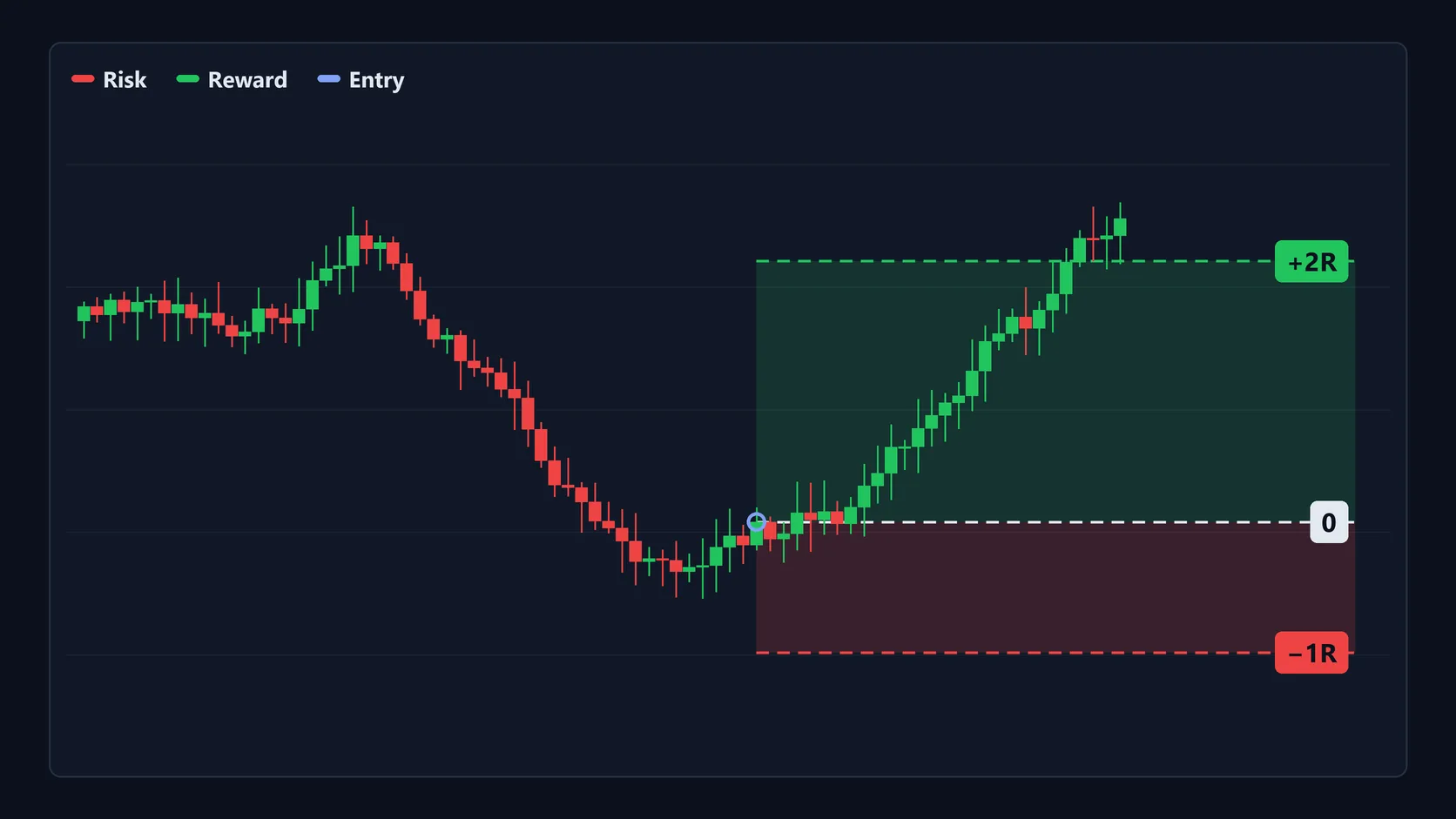
Short answer
A good trade (a buy and sell made to profit from a price move) is not the one that made money. It is the one that followed a plan written before the entry: the reason for the trade, the entry price, the exit point if it goes wrong, the target and a position size calculated so that a mistake costs little. A trade can be well executed and lose money, and another can be badly executed and win by luck. Learning to make good trades means learning to control the loss, because nobody controls the gain.
This guide shows how to build that plan, how to calculate position size, why fees and leverage weigh more than they seem and how to keep a trading journal. First, the numbers: most people who try to make a living from trading lose money, and it is worth knowing that before the first click.
Judge a trade by its process
A single trade says little about your skill. The price of bitcoin can fall 8% in a day because of news nobody expected, and your plan can still have been right. What you can judge in each trade is whether you did what you had decided to do.
| Situation | Result | Was it a good trade? |
|---|---|---|
| Followed the plan, hit the stop | Small, expected loss | Yes. The loss was within the limit |
| Followed the plan, hit the target | Gain | Yes |
| Entered without a plan, price went up | Gain | No. It was luck, and it teaches the wrong habit |
| Moved the stop to "give it more room" | Loss larger than planned | No |
The third row is the most dangerous. Winning without a plan reinforces the behavior that sooner or later produces the big loss.
What the data shows about people who trade
- Brazil, day trading index mini-futures: researchers from FGV and USP followed every individual who started day trading in the B3 equity futures market between 2013 and 2015 and kept at it for at least 300 trading days. About 97% lost money, and only 0.4% earned more than a bank teller's wage. The authors found no sign that people improve over time (Chague, De-Losso and Giovannetti, FGV EESP, February 2020).
- Europe, leveraged contracts (CFDs): in March 2018, ESMA, the European Union's markets authority, reported that 74% to 89% of retail accounts lost money on CFDs, with average losses of 1,600 to 29,000 euros per client. For crypto, ESMA capped retail leverage at 2 times the capital.
What this data does not allow us to conclude: neither study measures spot crypto trading. The first covers index futures in Brazil; the second, CFDs in Europe in 2018. They work as a warning about frequent, leveraged trading by individuals, not as the loss rate of today's crypto market.
The plan for each trade, in five lines
Write it before you enter. If it does not fit in five lines, the idea is not clear yet.
- Reason: why this trade, now. Example: "the price came back to an area that held the drops in recent weeks, with rising volume".
- Entry: the price or condition that triggers the buy.
- Stop: the price at which the idea is wrong and you get out. This is the stop loss order, which sells automatically when the price gets there.
- Target: where you take the gain, in full or in part.
- Size: how much to buy, calculated from the stop (next section).
Tools such as moving averages, RSI or volume help choose entry and stop. None of them replaces the plan; they only give it arguments.
Position size: the math that prevents the damage
Many people choose size by excitement ("I'll put R$ 3,000 into this one"). The safer path is the reverse: first decide how much you accept losing if the stop is hit, then calculate how much to buy.
A rule of thumb used by many traders is to risk between 0.5% and 2% of the trading capital on each trade. It is neither a law nor a guarantee; it is a limit that stops a few losses in a row from wiping out the account.
Illustrative example: you set aside R$ 10,000 for trading and decided to risk 1% per trade, that is, R$ 100. You are going to buy a coin at R$ 100 with a stop at R$ 95, a 5% distance.
- Position size = risk in money ÷ distance to the stop
- R$ 100 ÷ 0.05 = R$ 2,000
If the stop is hit, you lose about R$ 100, not R$ 500 or R$ 1,000. With a wider stop the position gets smaller; with a tighter stop, larger. The risk in money stays the same. In practice the loss can be slightly larger than planned, because in a fast drop the order may fill below the stop.
Why it matters: at 1% risk, ten losses in a row leave the account near R$ 9,000. At 10% risk per trade, the same ten losses take the account to around R$ 3,500, and getting back to the starting amount would require almost tripling what is left.
Risk, reward and win rate
The risk/reward ratio compares what you can lose with what you intend to gain. In the example above, a 5% stop and a 10% target give a ratio of 1 to 2. It sets how often you need to be right just to break even:
| Risk : reward | Minimum win rate to break even (before costs) |
|---|---|
| 1 : 1 | 50% |
| 1 : 2 | 33.3% |
| 1 : 3 | 25% |
The formula is risk ÷ (risk + reward). It looks like an invitation to always aim far, but distant targets tend to be hit less often. What matters is the combination of both over many trades, and only your records show that.
Costs: fees, spread and slippage
Three costs eat into the results of anyone who trades often:
- Trading fee: charged on the buy and on the sell. Check your exchange's fee table, because it changes with order type and volume.
- Spread: the gap between the best buy price and the best sell price. In thinly traded coins it can be large.
- Slippage: when the order fills at a worse price than expected, common in fast drops and in markets with little liquidity.
Illustrative example: with a hypothetical fee of 0.1% on each side, the R$ 2,000 position from the example pays about R$ 4 per round trip. It looks small, but it is 4% of the R$ 100 risk. Over a hundred trades, that is about R$ 400 in fees alone, before spread and slippage.
Leverage: when a small mistake becomes a liquidation
Leverage means trading with money lent by the exchange, through futures or margin contracts. With 10x leverage, a move of about 10% against you is enough to wipe out the margin, and the exchange usually closes the position before that, in what is called a liquidation. In crypto, 10% drops in a single day are not rare.
For someone still learning, the most prudent choice is to trade spot, without leverage, until you have your own track record. Leverage is exactly what ESMA pointed to as the cause of retail losses in Europe.
The trading journal
Without records, memory keeps the wins and erases the mistakes. A simple spreadsheet is enough. For each trade, write down:
- date, asset and exchange;
- planned reason, entry, stop, target and size;
- actual entry and exit prices, fees paid;
- result in money and in multiples of the risk (won 2 times what you risked, lost 1 time);
- whether you followed the plan and, if not, why.
Review in batches, not trade by trade. After a few dozen trades, look at the win rate, the average gain, the average loss, the total cost and, above all, how many times you broke your own rules. If the result is only positive in trades outside the plan, the problem is the plan.
The most common mistakes
- Moving the stop down to avoid "locking in" the loss.
- Trading to win it back right after a loss, with a bigger position.
- Entering late after a strong rally out of fear of missing out.
- Trading the news the minute it comes out, when spread and slippage are at their worst.
- Paying for signals from groups that only show their wins.
- Switching strategies every week, without enough data to know whether any of them worked.
Risks and precautions
- Market: crypto trades 24 hours a day, weekends included, and prices can gap past your stop.
- Custody and counterparty: to trade, the money sits on the exchange. Keep there only what is set aside for trading and see how to choose an exchange.
- Liquidity: small coins may have no buyer at the price you want when it is time to sell.
- Scams: be wary of "bots with daily profit", mentoring that promises income and anyone asking for access to your account. See also trading with AI.
- Tax: profit from selling crypto can be subject to income tax, and in Brazil the rules differ depending on whether the exchange is Brazilian or foreign. Frequent traders need to keep their history and check the current rules with the tax authority or an accountant.
- Emotional: frequent trading takes time and attention. If it is affecting your sleep, your work or money you need, stop.
Checklist before each trade
- The money used is only what I set aside for trading, and I can lose it without affecting bills or my emergency fund.
- I wrote down reason, entry, stop, target and size before entering.
- The risk of this trade, in money, is within the limit I set.
- I checked the exchange's fee and spread for this asset.
- I am not using leverage, or I know exactly at what price I would be liquidated.
- The stop order is placed on the exchange, not just in my head.
- I will record the result in the journal, win or lose.
Frequently asked questions
Is there a strategy that always works?
No. Every strategy goes through losing phases, and what worked in one period can stop working. That is why risk control comes before choosing a strategy.
How much money do I need to start trading?
There is no right minimum. It makes sense to start with a small amount you accept losing entirely while you learn, after building an emergency fund.
Is trading better than buying and holding?
They are different activities. Buying and holding takes few decisions and costs less in fees; trading takes time, rules and record keeping. The studies cited above show that most people who trade frequently lose money.
Should I always use a stop loss?
It is the simplest way to cap the planned loss. It does not guarantee the exact exit price in sharp drops, but without it a bad trade can turn into a loss much larger than expected.
Does a demo account help?
It helps you learn the platform and order types. It does not reproduce the fear of losing real money, so behavior on a real account is usually different.
Informational and educational content. It is not an investment recommendation, an offer or a solicitation to buy or sell assets.
Sources: Chague, De-Losso and Giovannetti, "Day Trading for a Living?", FGV EESP, Working Paper No. 525 (Feb 2020); ESMA: ban on binary options and restrictions on CFDs for retail investors (Mar 27, 2018). The numerical examples are illustrative. Checked on Oct 15, 2026.
Read more
- Risk, liquidity and discipline: how a good idea can become poor execution
- Technical indicators in crypto: the 7 most cited by experts and how to read each one
- Your first crypto plan: set limits before choosing an asset
- How to trade cryptocurrencies with AI: tools, risks and what to check
- Before your first crypto contribution: a simple plan to avoid impulse
- Main ways to invest in the crypto market
A sound market reading combines data, context and clear risk limits.