
Why big banks want to custody crypto — and which risks stay with the investor
BNY, U.S. Bank, Citi and Deutsche Bank have entered or announced crypto custody after US rules changed in 2025. See why, what a bank improves and which risks stay with you.
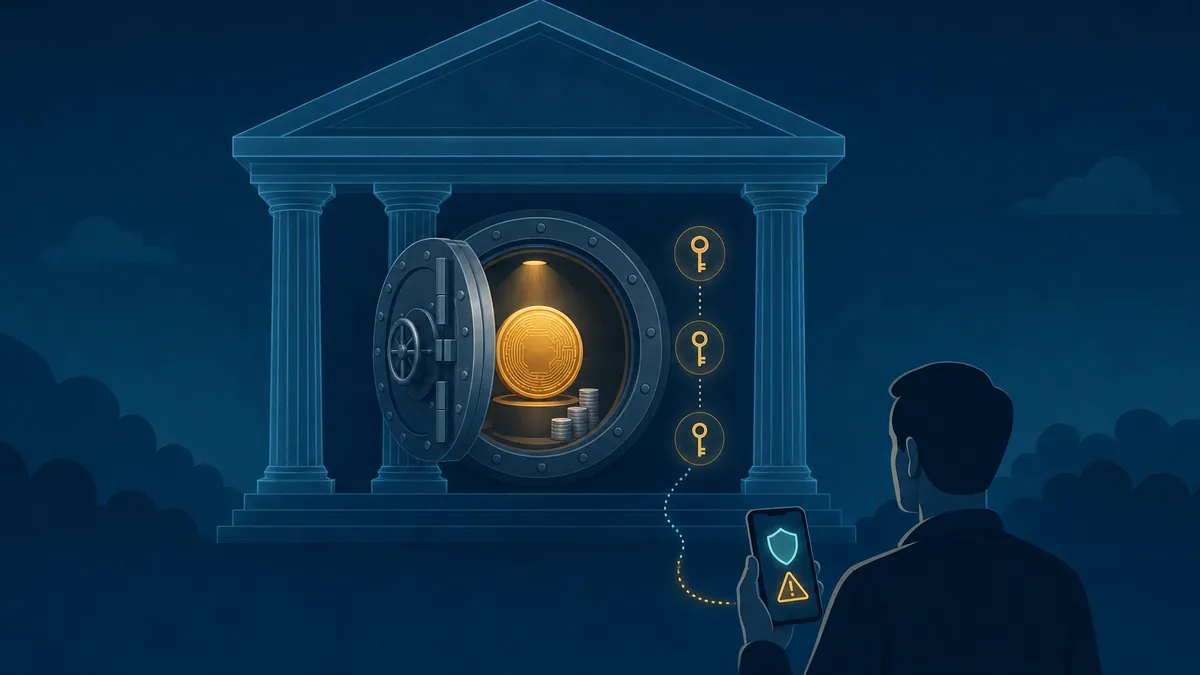
The short answer
Large banks are offering, or getting ready to offer, crypto custody — holding the keys that move bitcoin, ether and stablecoins on a client's behalf. In the US, BNY has offered the service since 2022, U.S. Bank resumed it in September 2025 and Citi said in August 2026 that it will start with bitcoin later this year. In Europe, Deutsche Bank announced in September 2026 custody of bitcoin, ether and stablecoins for institutional clients. The announcements came after the SEC withdrew, in 2025, accounting guidance that had made the service expensive for banks.
Having a bank in charge can reduce some risks, such as a company mixing client money with its own funds. But most of the investor's risks stay the same: the price can fall, crypto is not covered by deposit insurance (the FDIC in the US, the FGC in Brazil), the contract decides what is yours in a bankruptcy and, as a rule, you do not control the keys. This guide explains why banks want this business, what changes with them and what remains your responsibility.
What custody of crypto means
Whoever holds a crypto asset's private keys is the one who can move it. Custody means holding those keys for someone else. The July 2025 joint statement by the Federal Reserve, the FDIC and the OCC, the US banking regulators, describes exactly that: a bank only controls a crypto asset when it can show that no other party — including the customer — has enough information to transfer it on its own.
That makes the investor's choice clear. With self-custody, you hold the keys and take the risk of losing them. With third-party custody, whether a bank, an exchange or an ETF custodian, you trade that risk for trust in whoever holds them. Neither model removes risk; they only change where it sits.
Why big banks want this business now
1. The guidance that made the service expensive is gone
In 2022, the SEC published SAB 121, accounting guidance that led companies to record crypto held for clients as a liability on their balance sheet. For a bank, that made custody more costly, according to CoinDesk. On 23 January 2025, the SEC published SAB 122, which rescinded that guidance effective 30 January. In July 2025, the three banking regulators issued the joint statement on crypto safekeeping, which created no new rules but explained how existing ones apply. When it resumed the service in September 2025, U.S. Bank cited "greater regulatory clarity" for adding bitcoin ETFs to the offering.
2. Clients want everything in one place
The banks' argument is similar on both sides of the Atlantic. According to CoinDesk, Citi clients will be able to hold bitcoin within the same framework they already use for stocks and bonds. U.S. Bank added custody of bitcoin ETFs for fund managers. Deutsche Bank calls digital assets a "complement" to the traditional financial system, not a replacement.
3. Fees and relationships (our reading)
The announcements do not disclose expected revenue. Cripto View's reading is that custody is a recurring-fee and retention business: if a fund manager or company keeps crypto at another institution, the bank loses part of the relationship. This is an interpretation, not a figure the banks reported.
Who already offers it or has announced it
| Bank | Status | Assets and clients | Source |
|---|---|---|---|
| BNY (US) | Live since 11 Oct 2022 | Bitcoin and ether, selected institutional clients | BNY press release |
| U.S. Bank (US) | Resumed on 3 Sep 2025 | Bitcoin and bitcoin ETFs, institutional managers; NYDIG as sub-custodian | U.S. Bank press release |
| Citi (global) | Announced on 18 Aug 2026, no start date | Bitcoin first, institutional clients, on the Custody+ platform | CoinDesk |
| Deutsche Bank (Europe) | Announced on 16 Sep 2026, launch planned for 2026, subject to the regulator | Bitcoin, ether, USDC, EURC and EURAU; institutional and corporate clients, not retail | Deutsche Bank press release |
| Itaú (Brazil) | Buying and selling with in-house custody since 4 Dec 2023 | Bitcoin and ether at launch, investment clients, through the íon platform | Itaú Investor Relations |
On 17 October 2026, 24/7 Wall St. reported that Deutsche Bank was weeks away from launching in Germany; the bank has not given a date. Most of the services above are for institutions. For individuals in Brazil, the usual route is still an exchange or the bank's app, not an institutional custody account.
What a custodian bank can improve
- Controls and audit: the US joint statement lists as sound practice managed key generation and storage, a plan for lost or compromised keys, a focus on cybersecurity and audits of the operation, with outside help where in-house expertise is lacking.
- Segregated assets: US regulators note that if a sub-custodian commingles its own assets with clients' assets, those assets risk being treated as its property in a bankruptcy. In Brazil, the Central Bank's rules for virtual asset service providers also require client assets to be kept apart from the company's own (see the Central Bank rules for exchanges).
- Supervision: a bank is already closely supervised. That does not guarantee nothing goes wrong, but it gives the client a regulated counterparty.
The risks that stay with the investor
Price
Custody keeps the asset; it does not protect its value. Deutsche Bank itself wrote in its announcement that the service does not protect against price changes, fraud or failures of other market participants. If bitcoin falls 50%, it falls 50% inside the bank too.
No deposit insurance
In Brazil, the FGC covers a list of products — current accounts, savings, CDBs, LCIs, LCAs and a few others — up to R$250,000 per individual or company at each institution or financial group. Crypto is not on the list. In the US, the FDIC states that deposit insurance does not cover crypto assets. Deutsche Bank also warns that crypto has no deposit guarantee comparable to that of bank deposits. Buying bitcoin through a bank does not turn it into a deposit.
The contract decides what is yours
In a bankruptcy, what counts is what you signed. In January 2023, a New York bankruptcy court ruled that about US$4.2 billion (valued at the bankruptcy filing) held in Celsius "Earn" accounts was presumptively the company's property, not its customers', because the terms of use transferred ownership. Celsius was not a bank, but the lesson applies to any custodian: check whether the contract says the assets remain yours, whether they are segregated and whether they can be lent or reused.
Third parties you do not see
A bank may use a sub-custodian, a specialist firm that actually holds the keys. U.S. Bank uses NYDIG; Deutsche Bank says it uses external technology providers for parts of the service. US regulators point to two problems: if a sub-custodian commingles clients' assets with its own, they may be treated as its property in a bankruptcy; and if record-keeping or contingency planning falls short, an operational failure could leave clients without access for a long time or even permanently. Ask who actually holds the keys.
Pooled or individual account
Many custodians use an omnibus account, where several clients' assets sit together in the same wallet. According to the US statement, this model may be more efficient but creates a larger target for theft. The alternative, a separate wallet for each client, requires generating and managing many more keys. Ask which model the service uses.
You may not be able to withdraw to your own wallet
Not every bank lets you move assets to another wallet. At launch, in December 2023, Itaú said it was not possible to bring crypto in from, or send it out to, other wallets. Without that exit, you depend on the bank to sell and can only leave in reais. Check the current rule before buying.
Forks, airdrops and staking
When a blockchain splits (a fork) or distributes tokens (an airdrop), the custodian decides what happens. The US regulators' statement lists these cases among the points a well-written contract should cover, as well as governance votes and the type of storage (cold, hot or hybrid wallet). If the contract says nothing, do not count on those assets.
Rules still changing
The Basel Committee, which sets capital standards for banks worldwide, decided in 2026 to review parts of its standard on banks' crypto exposures; the outcome has not been published yet. In Brazil, the deadline for exchanges that were already operating to apply for Central Bank authorization ends on 30 October 2026. A service available today may change its scope, price or audience.
Checklist before leaving crypto with a bank
- Does the contract say the assets are yours and kept apart from the bank's own?
- Can the bank lend, invest or reuse your assets? Under what conditions?
- Who holds the keys: the bank itself or a sub-custodian? Which one?
- Is the wallet individual or omnibus?
- Can you withdraw to your own wallet? At what fee and how fast?
- What happens with forks, airdrops and staking?
- What are the custody, buy and sell fees?
- Do you understand there is no deposit insurance and the price can fall?
Bank, exchange or self-custody?
There is no single answer. A bank or a regulated exchange shifts operational risk to a supervised institution, but keeps contract, third-party and withdrawal risk. Self-custody removes dependence on third parties but demands discipline with backups and the recovery phrase; the crypto wallet guide explains the types. If you prefer exposure without handling keys, crypto ETFs are another route, with their own risks.
Frequently asked questions
Is crypto held at a bank covered by deposit insurance?
No. Brazil's FGC covers a list of banking products, such as savings and CDBs, and crypto is not on it. In the US, the FDIC does not cover crypto assets either.
If the bank fails, do I lose my crypto?
It depends on the contract and the law. If the assets are segregated and the contract says they are yours, they should not become part of the bankruptcy estate. Even so, recovery can be slow. Read the terms before buying.
Is a bank safer than an exchange?
A bank is already supervised and must follow control and audit rules, which can reduce some operational risks. That does not remove price risk, contract risk, sub-custodian risk or the lack of deposit insurance. An exchange authorized by Brazil's Central Bank must also keep client assets segregated.
Can I move my crypto from the bank to my own wallet?
Only if the bank allows it. Some services only let you sell and receive reais. Ask before buying.
Why are more US banks moving in now?
The announcements coincide with two changes: in January 2025, the SEC withdrew the SAB 121 accounting guidance that made custody expensive for banks, and in July 2025 the banking regulators explained how existing rules apply to the service. The banks do not detail all of their reasons.
Informational and educational content. It does not constitute investment advice, an offer or a solicitation to buy or sell assets.
Sources: Federal Reserve, FDIC and OCC: joint statement on crypto-asset safekeeping (14 Jul 2025); Crypto-Asset Safekeeping by Banking Organizations (full text, PDF); SEC: Staff Accounting Bulletin 122 (23 Jan 2025); BNY: digital asset custody platform launch (11 Oct 2022); U.S. Bank: bitcoin custody resumed (3 Sep 2025); CoinDesk: Citi plans bitcoin custody for institutional clients (18 Aug 2026); Deutsche Bank: digital asset custody solution (16 Sep 2026); 24/7 Wall St.: Deutsche Bank weeks from launch (17 Oct 2026); Itaú Unibanco: crypto trading via íon begins (4 Dec 2023, in Portuguese); Finsiders Brasil: Itaú launch terms (4 Dec 2023, in Portuguese); FGC: about the guarantee (in Portuguese); FDIC: deposit insurance and crypto (29 Jul 2022); Morrison Foerster: ruling on Celsius Earn accounts (Jan 2023); BIS: GHOS endorses review of the cryptoasset standard (9 Mar 2026). Accessed on 21 Oct 2026.
Read more
A sound market reading combines data, context and clear risk limits.